Origins
Where does it come from?
The Austrian Black and Tan Hound is a breed of very ancient origin. Its most probable ancestor would be the Keltenbracke, descended from the Celtic hounds long appreciated by hunters in northern Europe. The Fédération Cynologique Internationale definitively recognized the breed on 3 September 1954, and the official FCI standard currently cited was published on 10 October 1995. The breed is recognized by the FCI and the UKC.
Appearance
What does it look like?
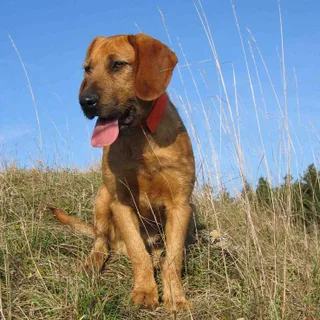
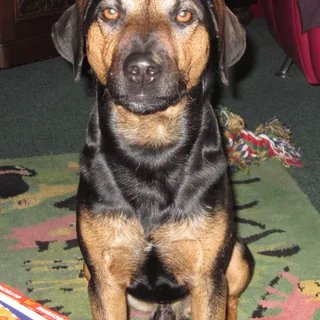
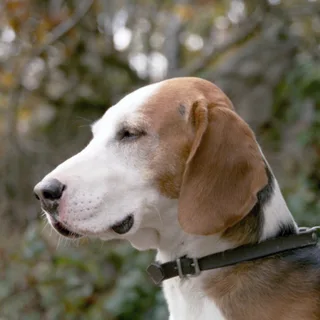
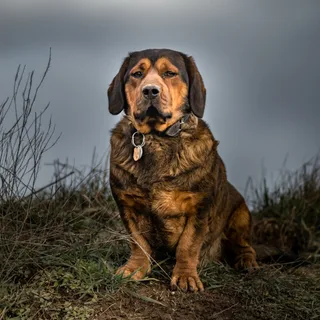
Of medium size and of solid build, the Austrian Black and Tan Hound presents an elongated and supple silhouette. Its head is long and gentle in expression, with a rather broad skull, a little marked occipital region, a black nose and an elongated and strong muzzle. Its dark brown eyes have a frank and gentle look. Its ears, set high, are of medium length, broad without excess, rounded at their tip and pendant. Its neck is of medium length and very strong, the withers well marked, the back long, the loin slightly raised, the croup a little sloping and the chest broad and well let down. Its tail is long, slightly curved, gradually tapered and pendant at rest, with a harsh hair forming a bump on its inner side. Its coat of about 2 cm is short, smooth, lying close, dense, supple, tight and shiny. The coat is black with clearly defined tan markings, from light fawn to dark fawn, notably above the eyes.
Temperament
Temperament and personality
The Austrian Black and Tan Hound has a pleasant temperament. Lively, attentive and reserved, it remains attached to its owner. When hunting, it shows itself determined and self-confident when it follows game, notably the hare, relying on an extremely keen sense of smell.
Living together
Living with children and other pets
A hunting dog above all, it requires a lot of freedom, activity and long outings. Brief walks are not enough to meet its needs. It is better suited to an experienced, calm, available owner who is able to offer it frequent exercise in large open spaces. Apartment living is only conceivable if its physical needs are fully met.
Training
Training and socialization
Relatively not very obedient, the Black and Tan Austrian Hound requires a firm, consistent and early education, without a power struggle. Recall training must begin from the youngest age, taking into account its pursuit instinct and its autonomy at work.
Budget
Price and budget for the Austrian Black and Tan Hound
The purchase price varies depending on the breeder, the lineage, the health guarantees and the dog's intended use, notably companionship or work.
See cost breakdownHealth
Health at a glance
The Austrian Black and Tan Hound is described as a dog with robust health, with no particular predisposition reported. In this hunting dog, the main risks are mainly linked to field activities, such as injuries and heatstroke.
Prevention and things to watch forNutrition
Feeding your pet well
The diet must support an active dog while taking into account its tendency to gain weight. Energy intake must be adjusted according to the intensity of outings and reduced when activity decreases.
Our feeding adviceDid you know?
Fun facts and popularity
The Black and Tan Austrian Hound is also known under the names Black and Tan Hound, Austrian Scenthound, Austrian Hound and Brandlbracke. The color of its coat recalls that of the Dobermann, the Rottweiler, the Pinscher, the Beauceron or the Gordon Setter.