Longevity
Life expectancy
It lives on average from 10 to 13 years. Weight control and screening for dysplasia in breeding animals strongly influence its quality of life.
Build
A robust breed?
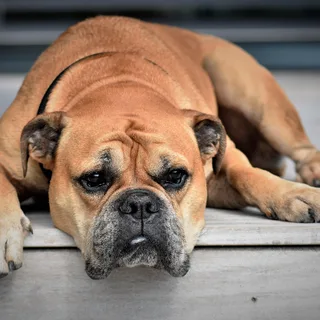
It is a sturdy and athletic dog for a bulldog. Its robustness depends greatly on the bloodlines: some very massive or very short-muzzled individuals lose the health advantage sought by the breed.
Watch points
What to watch for
The hips and elbows, the folds of the face, the eyelids (entropion, ectropion) and breathing in hot weather must be monitored.
Hip and elbow dysplasia : Common joint conditions in heavy dogs.
Entropion and ectropion : Abnormal rolling of the eyelids that can irritate the eye.
Breathing discomfort : Less pronounced than in the English Bulldog, but possible in subjects with very short muzzles.
Skin fold dermatitis : Facial folds can become infected without regular cleaning.
Climate
Cold and heat tolerance
It tolerates the cold quite well thanks to its muscle mass, but heat poorly, like all short-snouted dogs. In summer, outings take place during the cool hours.
Weight
Tendency to gain weight
Greedy and massive, he quickly gains weight. Being overweight worsens joint and respiratory problems: the ration must be weighed and activity regular.
Daily life
Good habits to keep it healthy
- Clean and dry the facial folds every week.
- Avoid any exertion in hot weather.
- Request the parents' hip and elbow X-rays.
Vaccination
Olde English Bulldogge vaccines: vaccination schedule
Which vaccines for a Olde English Bulldogge? Like all dogs, the Olde English Bulldogge receives essential vaccines from 8 weeks old: CHPPi (core vaccine) and Leptospirosis. The puppy primary vaccination for Olde English Bulldogge is given in several injections 4 weeks apart, followed by a first booster at 1 year. Depending on its lifestyle (hunting, hiking, boarding, travel, region), your veterinarian may complete the protocol with vaccines against Rabies, Kennel cough, Piroplasmosis, Lyme disease and Leishmaniasis.
| Vaccine | Primary series | First booster | Then | Who for? |
|---|---|---|---|---|
CHPPi (core vaccine)Core Distemper, Rubarth hepatitis, parvovirosis and parainfluenza | 8 weeks · 12 weeks · 3 months | 1 year | every year | All pets |
LeptospirosisCore Leptospirosis (bacterium transmitted by rodent urine and stagnant water) | 8 weeks · 12 weeks | 1 year | every year | All pets |
RabiesLifestyle-based Rabies | 12 weeks | 1 year | every year | Mandatory for travel abroad, categorized dogs, most boarding kennels and shows |
Kennel coughLifestyle-based Bordetella bronchiseptica and parainfluenza | 8 weeks | 1 year | every year | Dogs attending boarding kennels, daycares, dog clubs and shows |
PiroplasmosisLifestyle-based Tick-borne babesiosis | 5 months · 6 months | 1 year | every year | Hunting dogs, dogs living in rural or wooded areas, dogs highly exposed to ticks |
Lyme diseaseLifestyle-based Tick-borne borreliosis | 12 weeks · 3 months | 1 year | every year | Hiking dogs, hunting dogs, forest areas of the East and the Center |
LeishmaniasisLifestyle-based Leishmaniasis transmitted by sandflies | 6 months | 1 year and 6 months | every year | Dogs living or staying in the South of France, Corsica and the Mediterranean basin |
Adult Olde English Bulldogge vaccine boosters are annual for leptospirosis and rabies; for distemper, hepatitis, and parvovirus, a booster every three years is often sufficient after the first booster. Your veterinarian will adjust the schedule to your dog’s actual risk.
Which boosters for your Olde English Bulldogge?
Enter your companion’s age: we list the vaccines to do now and the next boosters.
Adopting well
Adopting a healthy Olde English Bulldogge
Breeding dogs should be X-rayed for hip and elbow dysplasia. An eyelid examination and a respiratory assessment are also useful.
This information is provided for guidance only and does not replace a veterinarian’s advice. If you have any concerns about your pet’s health, consult a professional.