Origins
Where does it come from?
In the 13th century, the ancestors of the English Bulldog were selected in England for bull-baiting, a practice that pitted dogs against bulls. After the ban on this activity in 1837, the breed became rare before being preserved by enthusiasts who steered its selection toward a companion dog. Its historic courage thus became associated with a temperament that is now affectionate and sociable. The breed, also called Bouledogue anglais or English Bulldog, bears FCI number 149, was recognized in 1955 and belongs to group 2. The current standard has been in force since 2010.
Appearance
What does it look like?
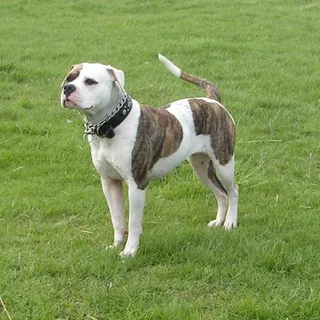
The English Bulldog has a stocky silhouette, low on legs and endowed with a powerful chest. Its round head, very imposing in relation to the body, has a rather flat forehead, a frontal furrow and numerous folds. Its black eyes are round and of medium size, while its small ears are curved and well spaced. Its very short, smooth and fine coat can be solid or parti-coloured, in various shades including red, fawn and white, sometimes with a black mask. Its round tail, short and covered with a non-harsh coat is not carried above the topline.
Temperament
Temperament and personality
Behind his grumpy expression, the English Bulldog is affectionate, docile and very attached to his family. Generally calm, he enjoys play and the company of children. He is protective towards his own and can remain wary with strangers. His intelligence comes with strong independence and a certain stubbornness, which requires a consistent and respectful relationship.
Living together
Living with children and other pets
The English Bulldog enjoys a quiet life at home and can stay lying down near its loved ones for long periods. It adapts well to apartment living if its daily needs are met. Short regular walks suit it better than prolonged exertion. Its sociability with other animals is generally correct when it has been accustomed early and interactions with children must, as for any dog, remain supervised.
Training
Training and socialization
Sensitive and stubborn, the English Bulldog responds best to early training that is firm without brutality, consistent and based on positive reinforcement. The rules must be clear and constant, notably learning refusal and calm. Short and motivating sessions limit boredom. A reprimand he considers unfair can make him dig in his heels, while attention, patience and reward encourage his cooperation.
Budget
Price and budget for the English Bulldog
The purchase price depends in particular on the lineage, the pedigree, the reputation of the breeding kennel and the health guarantees provided. You must also anticipate a substantial maintenance and health budget for this breed with limited robustness.
See cost breakdownHealth
Health at a glance
The English Bulldog requires careful health monitoring due to its brachycephalic morphology and its sensitivity to extreme temperatures. Its endurance is limited and any unusual shortness of breath, breathing discomfort or back pain warrants prompt veterinary advice.
Prevention and things to watch forNutrition
Feeding your pet well
The diet must support its muscle mass while avoiding excess weight, which worsens respiratory and joint difficulties. The ration is chosen according to age, weight, activity, body condition and any possible medical needs.
Our feeding adviceDid you know?
Fun facts and popularity
The English Bulldog is also known by the names Bouledogue anglais and English Bulldog. Despite its sturdy appearance, it has little stamina and prefers moderate activities. A litter usually has 4 to 5 puppies. Its past as a dog used for bull-baiting contrasts strongly with its current role as a calm and affectionate family companion.