Origins
Where does it come from?
The Norwich Terrier originates from England, in the Norwich region, in the heart of the county of Norfolk. Until the middle of the 19th century, it was not clearly distinguished from the Norfolk Terrier, the two breeds sharing the same origins and a similar use for hunting vermin. Selection gradually established a small rustic, courageous and compact terrier, whose most visible difference from the Norfolk Terrier remains the carriage of erect ears. The breed was registered with the English Kennel Club in 1932 and then definitively recognized by the FCI on 16 October 1954.
Appearance
What does it look like?
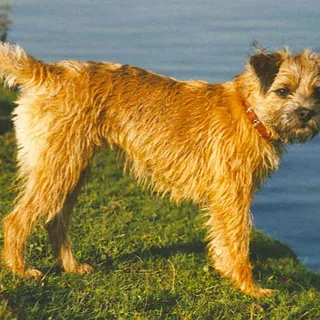
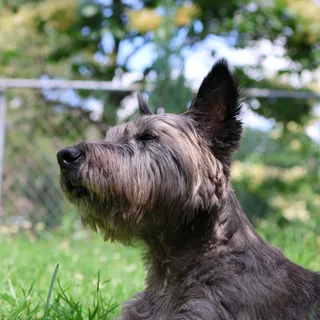
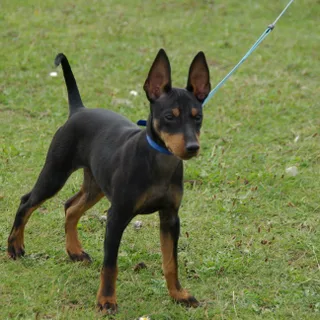
The Norwich Terrier is one of the smallest terriers, but it gives an impression of remarkable sturdiness. Low on legs, compact and well built, it has a short back, a well let-down chest and a level topline. Its head is broad and slightly rounded, its oval eyes express a lot of liveliness and its triangular ears are carried erect when alert. Its harsh, straight coat lying close to the body is backed by a dense undercoat, with well furnished whiskers and eyebrows. The accepted colours range from wheaten to red, black and tan or grizzled.
Temperament
Temperament and personality
The Norwich Terrier is an energetic, lively, fearless and lovable dog. Very attached to its home, it is affectionate with its loved ones and generally sociable with humans as well as with other dogs. Its terrier instinct, however, remains very present, which can make it pushy with small animals. It is also a good little watchdog, attentive to unusual movements and quick to signal a visitor.
Living together
Living with children and other pets
On a daily basis, the Norwich Terrier is alert, curious and dynamic. It can live in an apartment if its outings are regular and sufficiently stimulating, but it also greatly appreciates a house with a well-fenced garden. Its small size makes urban life easier, provided its need for activity is not underestimated. Without occupation or frequent walks, it can become noisier or restless.
Training
Training and socialization
The education of the Norwich Terrier must be early, consistent and fair. Intelligent and receptive, he learns well when the sessions are short, lively and positive. Like many terriers, he keeps a part of independence and a chasing instinct that require a good recall and stable rules. Early socialization with humans, other dogs and small animals helps to channel his temperament and to promote harmonious cohabitation.
Budget
Price and budget for the Norwich Terrier
The Norwich Terrier remains an uncommon breed, which explains a price positioning that is often high at purchase. The price depends mainly on the quality of the breeding, the lineage, the health tests carried out and the local availability of puppies.
See cost breakdownHealth
Health at a glance
The Norwich Terrier is overall a robust breed, well suited to an active life and able to tolerate the cold well thanks to its double coat. As with many small hardy dogs, prevention and regular care often help maintain a good quality of life for many years.
Prevention and things to watch forNutrition
Feeding your pet well
The Norwich Terrier has modest dietary needs in terms of volume, but it benefits from receiving good-quality food, nutrient-dense and adapted to its age, its activity and its body condition. Its small size does not allow approximations, because a few excesses can quickly unbalance its ration.
Our feeding adviceDid you know?
Fun facts and popularity
The Norwich Terrier is very close to the Norfolk Terrier, to the point that the two were long considered as a single breed. The simplest sign to tell them apart is the ear: erect in the Norwich Terrier, drooping in the Norfolk Terrier. Historically, this small dog was appreciated for its ability to hunt rats and other pests while remaining a pleasant companion at home.