Origins
Where does it come from?
The Keeshond is the large grey spitz, or Wolfsspitz, which became the barge dog and the Dutch patriotic symbol in the 18th century. It belongs to the German Spitz family, of which it is the largest variety along with the Giant Spitz. Its name comes from Kees, a nickname linked to a political party of the time. In the 20th century, the breed became established as a companion dog, while keeping its alert bark and its spectacular coat.
Appearance
What does it look like?
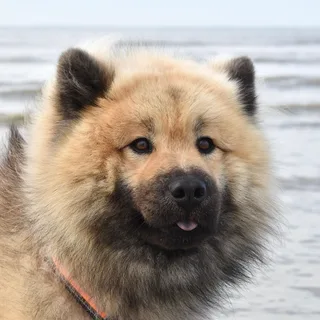
Medium-sized Spitz, almost square, with a smiling expression. The head is wedge-shaped, the muzzle neither too long nor too pointed, the ears small and erect. The double coat forms a ruff, breeches and a plumed tail curled over the back. The coat is wolf grey, lighter on the spectacles, the legs and the plume. The undercoat is very dense.
Temperament
Temperament and personality
Affectionate, sociable and fairly easy-going in the family, he likes to take part in household life. He alerts by voice more than he really guards. With children, he is generally patient. He can be sensitive to loneliness and sudden changes.
Living together
Living with children and other pets
He adapts to apartment living if he is accepted as a dog that sheds and barks. He needs daily walks, not an extreme sport. Heat bothers him. At home, he follows his humans and comments on the slightest noise on the landing.
Training
Training and socialization
Cooperative and intelligent, he learns quickly if you stay consistent. Barking is managed through habit and reinforcing calm, not by shouting. Early socialization prevents the wariness of the companion spitz.
Budget
Price and budget for the Keeshond
A companion Keeshond from a well-monitored breeding program is often priced between 1 000 and 1 800 euros. Grooming work and health tests justify a higher price than that of a non-monitored spitz.
See cost breakdownHealth
Health at a glance
Beautiful dog, but certain lines carry hormonal, skin or neurological predispositions. Breeding that tests and that refuses overly heavy subjects clearly improves the prognosis. The undercoat requires maintenance to avoid skin problems.
Prevention and things to watch forNutrition
Feeding your pet well
The Keeshond needs a complete, digestible diet adjusted to its age, its activity and its body condition. Protein quality and control of energy intake matter as much as the volume of the ration.
Our feeding adviceDid you know?
Fun facts and popularity
It is recognized by its lighter “spectacles” around the eyes. On barges, it served as an alert and a companion. In Germany, the standard still classifies it as Wolfsspitz within the German Spitz.