Origins
Where does it come from?
The Pharaoh Hound developed in Malta after the arrival of its ancestors on the Mediterranean archipelago around 1000 years before Christ. It shares origins with other primitive Mediterranean sighthounds such as the Cirneco dell'Etna, the Podenco Canario and the Ibizan Hound. The breed was then introduced to England at the beginning of the 20th century, then definitively recognized by the FCI in 1963.
Appearance
What does it look like?
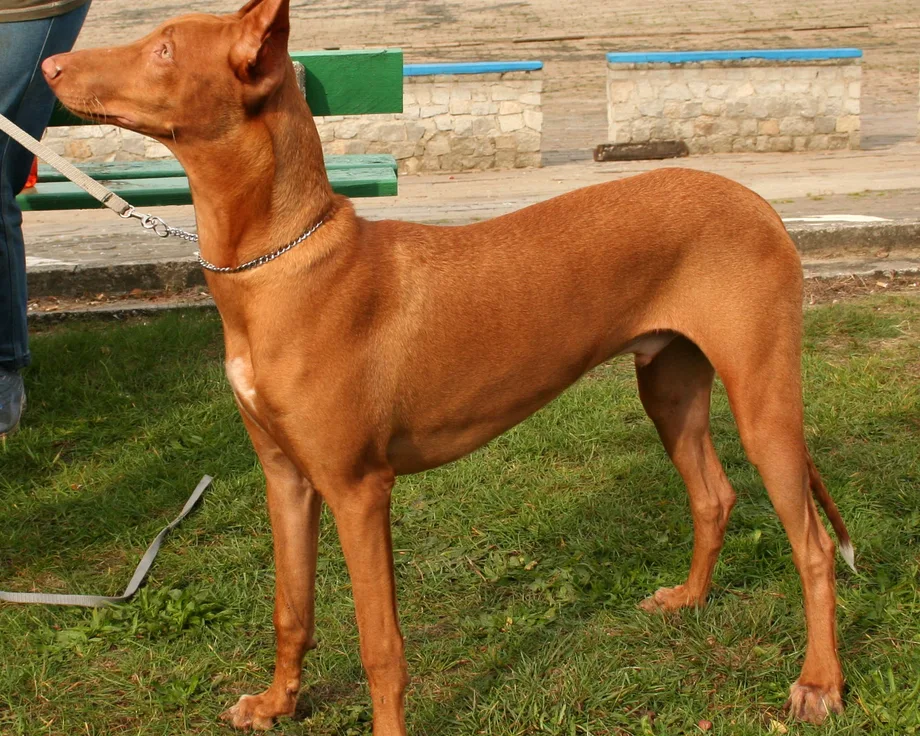
The Pharaoh Hound is a medium-sized dog, lean, supple and harmonious, whose silhouette fits slightly into a rectangle. Its outline is pure and elegant, with a well let-down chest, a slightly tucked-up belly, a long head in a truncated cone, erect and very mobile ears, and a whip-shaped tail. Its coat is short, fine and glossy, generally reddish-brown to dark reddish-brown, sometimes marked with white on the chest, the toes, the tip of the tail or on the face.
Temperament
Temperament and personality
Lively, intelligent and very alert, the Pharaoh Hound combines sensitivity, family attachment and a pronounced hunting instinct. He is affectionate and playful with those close to him, generally friendly with humans, while remaining attentive and enthusiastic as soon as he is in action. His natural vigilance comes with little barking, which makes him a discreet dog at home.
Living together
Living with children and other pets
On a daily basis, this dog needs exercise, stimulation and regular outings to stay balanced. He likes to run, play and use his senses, especially his sight and his sense of smell. If he gets enough exercise, he can be clean, calm and pleasant to live with, but boredom and lack of activity do not suit him well.
Training
Training and socialization
Its training must be early, consistent and firm without harshness. The Pharaoh Hound learns well when one relies on gentleness, regularity and motivation, but its sensitive temperament and its primitive nature require patience. Recall, management of the chase instinct and good living habits must be worked on from the youngest age.
Budget
Price and budget for the Pharaoh Hound
The price of a Pharaoh Hound varies depending on the lineage, the seriousness of the breeding, the screenings and the socialization. The maintenance budget (food, veterinary, training) often exceeds the purchase price over time.
See cost breakdownHealth
Health at a glance
The Pharaoh Hound is considered an overall robust breed, with no major predisposition systematically reported. Its main practical sensitivity comes above all from its short, fine coat, which protects it less from cold and bad weather than in breeds with a more abundant coat.
Prevention and things to watch forNutrition
Feeding your pet well
The diet of the Pharaoh Hound must support a lean silhouette, good muscle mass and an often high activity level. A complete and digestible food, adjusted to age, actual weight and exercise pace, helps preserve its athletic condition.
Our feeding adviceDid you know?
Fun facts and popularity
The breed name evokes ancient Egypt because of its noble appearance and its resemblance to certain dogs depicted in ancient iconography, but the modern breed is closely linked to Malta. It is also known by the English name Pharaoh Hound and remains relatively rare outside its circles of enthusiasts.