Origins
Where does it come from?
The Norwegian Hound breed was developed from the first half of the 19th century. Its other name, Dunker, was chosen in reference to its creator, the Norwegian captain Wilhelm Conrad Dunker. He crossed several varieties of hounds to obtain subjects close to the current standard. Numbers fell sharply during the Second World War, raising fears of the breed's disappearance. A renewed interest was then observed, notably in the 1970s, but the population remains quite small.
Appearance
What does it look like?
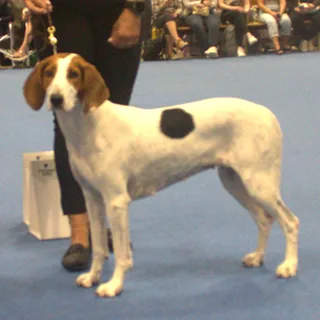
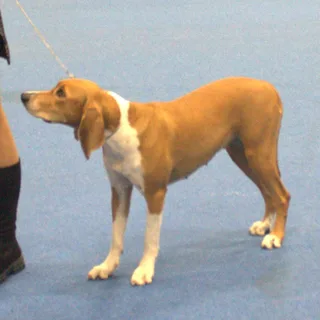
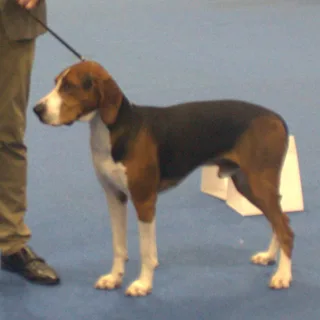
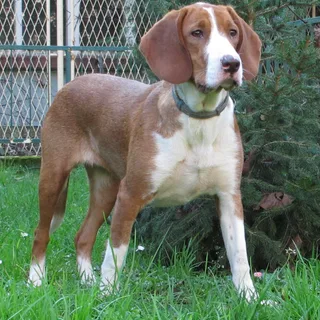
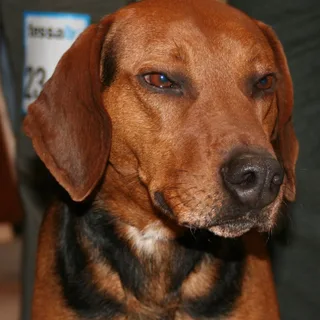
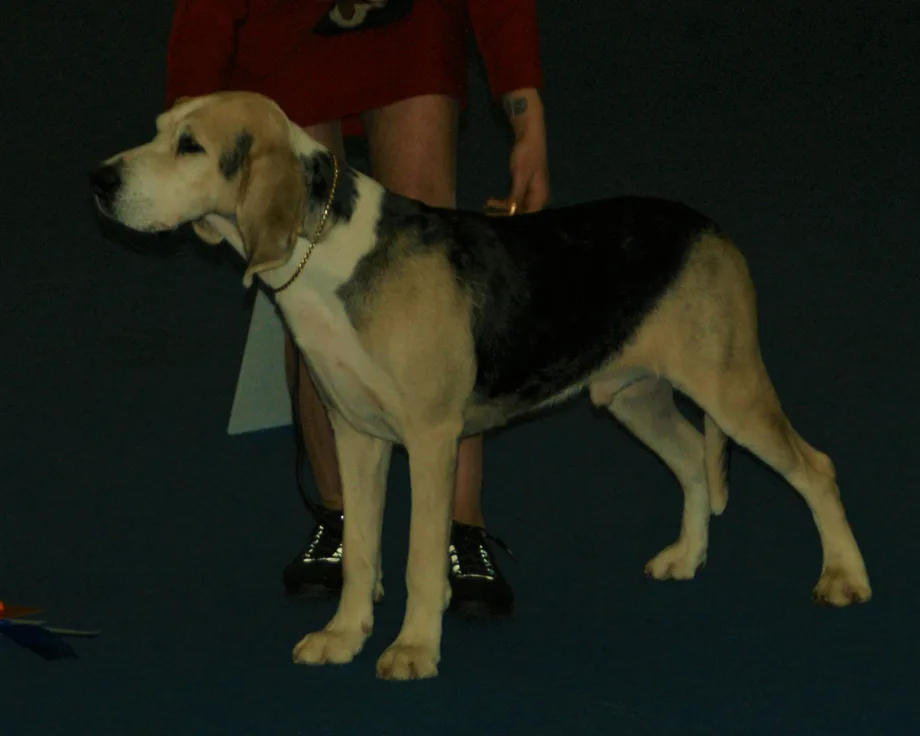
The Norwegian Hound is a medium-sized hunting dog, robust and hardy, whose outline fits into a rectangle without appearing heavy. Its rather elongated head has a slightly arched skull, a well-defined stop, a black nose and a fairly long, square muzzle. Its dark, round and expressive eyes show a calm and serious look. Its supple, pendulous and rounded ears are set at medium height. The neck is fairly long, the back straight and firm, the loin strong, the croup muscular and the chest rather broad. The tail, thick at the base, is carried straight or slightly curved. The coat is straight, harsh, dense and more abundant on the back of the thighs and on the tail. The coat color is diluted black with tan markings, or blue merle with darker markings.
Temperament
Temperament and personality
Resistant and enduring, the Norwegian Hound brings together the qualities of an efficient hunting partner. Endowed with strong nerves and a balanced temperament, it is known to be sociable and trustworthy. Attached to its owner and its family, it shows itself affectionate without losing its scenthound abilities.
Living together
Living with children and other pets
Its hunting instinct is very pronounced and its energy level is high. It needs long daily outings and regular activities to maintain its balance. Sociable with humans and generally able to get along well with its fellow dogs, it remains vocal and may bark or howl readily. It is not suited to apartment living or to small spaces.
Training
Training and socialization
The Norwegian Hound is not considered particularly difficult to train. Its attachment to its owner, its balanced temperament and its motivation for work make learning easier. The basics, in particular recall, must be taught from the youngest age. Its natural sociability promotes getting along with others, but its hunting instinct requires consistent training.
Budget
Price and budget for the Norwegian Hound
The purchase price depends in particular on the breeder, the lineage, the sex, the age and compliance with the standard. The rarity of the breed can also limit the available supply.
See cost breakdownHealth
Health at a glance
With a hardy constitution, the Norwegian Hound generally enjoys robust health when it receives appropriate care. No systematic predisposition to a particular disease is reported for the breed, but vigilance is recommended regarding certain orthopedic, auditory, ocular and skin conditions.
Prevention and things to watch forNutrition
Feeding your pet well
The Norwegian Hound needs a quality, balanced diet adapted to its age, its size as well as its level of physical activity. Its needs increase during hunting periods.
Our feeding adviceDid you know?
Fun facts and popularity
The name Dunker pays tribute to the Norwegian captain Wilhelm Conrad Dunker, creator of the breed. The Norwegian Hound bears number 203 in the FCI nomenclature and has been recognized by the FCI since 1956 as well as by the UKC. Despite the renewed interest observed from the 1970s onwards, its numbers remain limited.