Origins
Where does it come from?
The Donskoy appears for the first time in Russia, in the Rostov region, during the 1980s. Irina Kovaleva takes in from the street a blue-cream female cat named Varya, then mistreated by children, then observes that she gradually loses her fur. Varya then gives birth to several kittens showing the same hairlessness. This genetic particularity, distinct from the Sphynx mutation, leads to the establishment of a breeding program and to the recognition of the Donskoy as a breed in its own right.
Appearance
What does it look like?
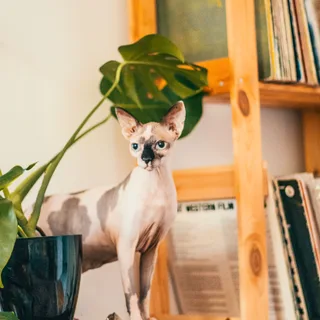
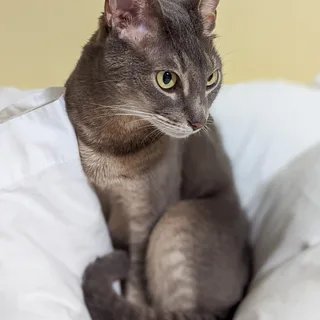
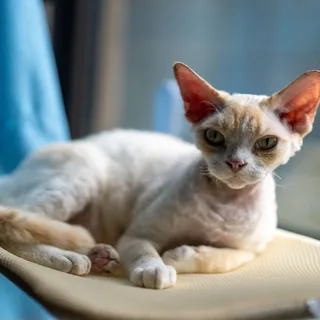
The Donskoy has a semi-foreign format, well built, muscular and elegant, with a broad croup and elastic skin forming numerous folds, especially on the head, in the armpits, on the belly and in the groin. The coat is absent, but a slight down may be accepted on the muzzle, ears, feet and the tip of the tail. Its wedge-shaped head has prominent cheekbones, forehead wrinkles and a medium nose. Its large almond-shaped eyes are set at an angle and their color depends on the coat. Its ears are large, slightly tilted forward and rounded at the tip. Its tail is long and thin. All colors are accepted. The female measures from 20 to 25 cm and weighs from 3 to 6 kg, while the male measures from 22 to 28 cm and weighs from 4 to 7 kg.
Temperament
Temperament and personality
The Donskoy is extremely kind, gentle, sociable and affectionate, without marked aggressiveness. Very attached to its owner and its family, it likes to follow them around the home and tolerates solitude poorly. Active, curious and intelligent, it enjoys discovering its environment as well as playing with adults and children.
Living together
Living with children and animals
Always on the move, the Donskoy readily seeks company and can be quite clingy. It adapts to life in an apartment as well as to a house with a garden, but indoor living makes it easier to protect it from extreme temperatures. In an apartment, it must have accessories to expend energy and keep itself entertained, notably a cat tree. It is sociable with children, other animals and people it does not know.
Training
Training and socialization
Very sociable and intelligent, the Donskoy easily learns routines, transport and a few targeted games. Getting used to handling, baths and skin care should start early, always gently.
Budget
Donskoy price & budget
The purchase price depends on the individual and the breeding. The source also indicates an estimated annual maintenance cost between 200 and 400 euros.
View cost breakdownHealth
Health at a glance
The Donskoy generally enjoys robust health. Its hairlessness nevertheless makes it vulnerable to cold and it is prone to lung infections, particularly during the winter period. Vaccination against common feline diseases, notably rabies, typhus, leukemia and coryza, contributes to its protection.
Prevention & watch pointsDiet
Feed it well
The Donskoy needs a sufficiently energy-rich diet to compensate for the calories used to maintain its body temperature in the absence of a coat.
Our feeding adviceDid you know?
Anecdotes and popularity
The Donskoy is also called Don Sphynx, Sphynx of the Don or Don Hairless. Although it is, like the Sphynx, one of the few hairless cat breeds, its genetic particularity is distinct from the mutation at the origin of the Sphynx.