Origins
Where does it come from?
The Peterbald is a recent feline breed that appeared in Russia in 1994. It comes from an initial cross between a Donskoy and an Oriental, carried out by the breeder Olga S. Mironova to bring together Oriental elegance and the distinctive skin of the Donskoy. Subsequently, crosses with the Donskoy became rarer in favor of matings with Siamese and Orientals, and a first standard was drafted in Russia in 1996.
Appearance
What does it look like?
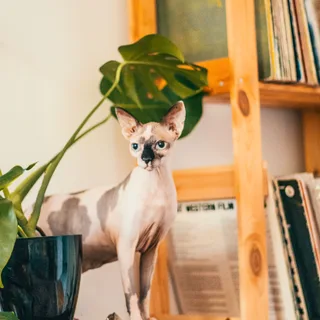
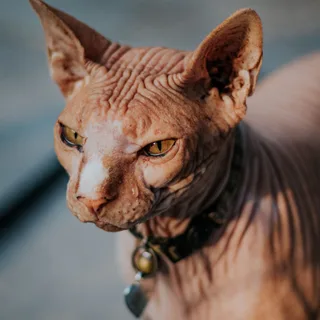
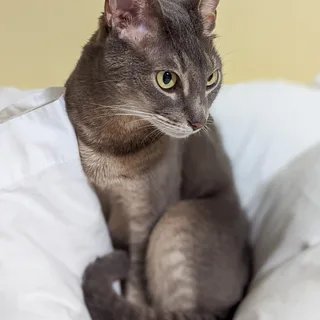
The Peterbald is an Oriental-type cat, long-limbed, athletic and elegant, with fine but firm musculature. Its head is long and triangular, its eyes are almond-shaped and its ears are large, wide at the base and well spaced. Its tail is long and there are several coat varieties, from the hairless cat to the subject covered with very short hair, even brush, with short, curly and harder hair.
Temperament
Temperament and personality
The Peterbald is an expressive cat, very close to its human, lively, extroverted and often talkative. It constantly seeks attention and affection, tolerates solitude poorly and likes to follow its owner throughout the house. It generally gets along well with children, other cats and other animals when it is properly socialized.
Living together
Living with children and animals
Very active on a daily basis, the Peterbald needs regular interactions, games and an enriched environment. It can live in an apartment if it is well arranged with perches, scratching posts and a cat tree, but it also appreciates space to burn off energy. Its strong need for presence makes it a companion better suited to available households than to prolonged absences.
Training
Training and socialization
The education of the Peterbald is based on consistency, enrichment and positive reinforcement. This intelligent cat quickly learns household routines, accepts care better when it is accustomed to it early and responds well to short, playful sessions. It is important to offer it daily interactions to channel its energy and prevent boredom.
Budget
Peterbald price & budget
The Peterbald remains a rare breed, which explains a purchase price that is often high compared to more widespread cats. The price mainly depends on the seriousness of the breeding, the lineage, compliance with the standard, and the health guarantees provided.
View cost breakdownHealth
Health at a glance
The Peterbald is generally a robust cat, but its lack of fur or very reduced coat requires particular vigilance for the skin and thermoregulation. It rarely gets sick when it is well monitored, but it is advisable to maintain the usual preventive care for cats and to watch for sensitivities specific to hairless breeds.
Prevention & watch pointsDiet
Feed it well
The Peterbald’s diet must cover the needs of an active cat while avoiding overfeeding. A complete, high-quality food, suited to its age, activity level and body condition, forms the basis of its nutritional balance.
Our feeding adviceDid you know?
Anecdotes and popularity
The name Peterbald refers to Saint Petersburg, cradle of the breed, and to the English word bald which means hairless. Despite its image as a naked cat, the breed includes several skin and coat textures, from the completely naked subject to the subject covered with a very short down or a brush coat. The standard often favors the velour variety.