Origins
Where does it come from?
The Cornish Rex appeared in Cornwall, in the United Kingdom, in 1950, when a kitten named Kallibunker was born with a naturally curly coat within an ordinary litter. The observation and then the breeding of this particularity made it possible to establish the breed. A few crosses with cats with a classic coat then helped to develop the modern Cornish Rex, today recognized for its slender silhouette, its wavy coat and its temperament very attached to humans.
Appearance
What does it look like?
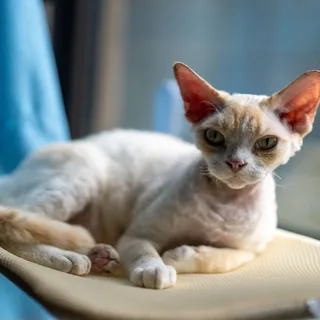
The Cornish Rex is an oriental-type cat, elegant and muscular, with a deep chest, a slightly arched back and a powerful hindquarters. Its legs are fine but firm, its tail is long and whip-like, and its elongated head bears very large ears set high. Its most striking feature remains its short, soft, dense and silky coat, made up of small regular waves and devoid of true guard hairs.
Temperament
Temperament and personality
The Cornish Rex is a very affectionate, playful and curious cat, which often retains kitten-like behavior into adulthood. It seeks closeness to its owner, willingly follows them around the house and greatly enjoys interaction. Sociable, charming and lively, it generally gets along well with children and accepts other animals fairly well when it is properly socialized.
Living together
Living with children and animals
Active and expressive, the Cornish Rex likes to climb, run and explore its environment. It copes well with apartment living if it is enriched with games, observation posts and a cat tree. It tolerates prolonged solitude poorly and can become demanding when its needs for attention, stimulation and companionship are not sufficiently met.
Training
Training and socialization
The Cornish Rex learns quickly and responds well to gentle, consistent and stimulating training. Routines, interactive play and positive reinforcement are particularly well suited to this intelligent cat that is close to humans. It is useful to offer it simple rules, calm handling and varied activities from an early age to channel its energy and maintain its curiosity.
Budget
Cornish Rex price & budget
The Cornish Rex is a breed that is still relatively rare, which influences its price level. The price varies mainly depending on the lineage, the reputation of the cattery, compliance with the standard and the kitten’s intended purpose, pet or breeding.
View cost breakdownHealth
Health at a glance
The Cornish Rex generally enjoys rather robust health overall. Its main point of vigilance concerns its sensitivity to cold, linked to its fine coat and the absence of a true topcoat. As with all cats, regular veterinary follow-up, vaccination and good lifestyle hygiene remain essential.
Prevention & watch pointsDiet
Feed it well
The Cornish Rex needs a complete and balanced diet, adapted to its age, its activity level and its morphology. Good-quality kibble, possibly combined with wet food, is well suited if it properly covers its energy and nutritional needs.
Our feeding adviceDid you know?
Anecdotes and popularity
The Cornish Rex is often described as a cat with an almost canine behavior, because it likes to follow its human from one room to another and take part in household life. Its curly coat, rare in cats, gives it a very distinctive appearance and a silky feel. Despite its delicate look, it is a fast, lively and surprisingly athletic cat.