Origins
Where does it come from?
The German Rex was born in Germany from a spontaneous genetic mutation. The breed appeared in 1946 with Lämmchen, a female cat discovered in the gardens of a hospital. Her descendants had a curly, dense and tight coat, reminiscent of that of the Cornish Rex while differing from it in its structure. Officially recognized in 1982, the breed remains rare and is clearly less widespread outside Germany than the Devon Rex or the Cornish Rex.
Appearance
What does it look like?
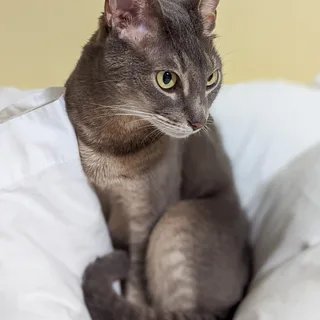
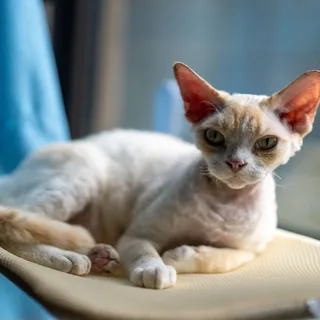
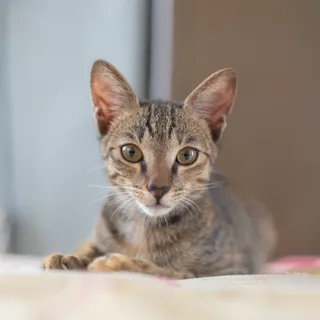
Of medium size and semi-foreign type, the German Rex has a body that can be inscribed in a rectangle, a broad chest, a solid bone structure and powerful musculature. Its head, longer than it is wide, shows developed cheeks, a slightly rounded forehead, a straight nose, a strong muzzle and a not very marked stop. The ears are medium, broad at the base and rounded at the tip. The eyes, round or slightly slanted, range from orange to green via yellow, bright shades being sought after. The tail, of medium length, broad at the base then tapered, carries an abundant coat. The short and plush coat forms tight waves, without guard hairs, and the whiskers are short and curly. All colours are accepted except notably chocolate, lilac, cinnamon and fawn.
Temperament
Temperament and personality
Demonstrative, gentle and balanced, the German Rex is a patient and very sociable cat. It becomes attached to its owner and the whole family, is attentive with children and generally appreciates the company of its fellow cats as well as that of other animals. Its liveliness and taste for play are accompanied by great tenderness, without an excessively noisy temperament.
Living together
Living with children and animals
The German Rex adapts just as well to apartment living as to a rural environment. Indoors, it seeks interactions, games and closeness to its family. If it has access to a secure outdoor area, it likes to run, climb and express its hunting skills. It tolerates very low winter temperatures poorly and will readily ask to come back inside, sometimes with a few meows.
Training
Training and socialization
Intelligent, close to humans and motivated by play, the German Rex easily learns the household rules with a positive and consistent method. Early socialization, gentle handling and short rewarded sessions make it easier to use the scratching post, the carrier and routine care. Its energy must be channeled through interactive games and elevated routes rather than through restraint.
Budget
German Rex price & budget
The German Rex is a rare breed, especially outside Germany, which limits the number of litters available and can lengthen the adoption waiting time. The price varies notably depending on the quality of the lineage, the pedigree, the cat’s destination, the care already provided and any possible travel expenses.
View cost breakdownHealth
Health at a glance
The German Rex is considered robust and no genetic pathology specific to the breed is currently known. It must nevertheless benefit from the same preventive monitoring as any cat, notably against panleukopenia, cat flu and feline leukemia depending on its lifestyle, as well as against rabies when regulations or travel require it. Its short coat without guard hairs makes it more sensitive to intense cold.
Prevention & watch pointsDiet
Feed it well
The German Rex needs a complete diet, adapted to its age, its weight, its activity level and its neutering status. A measured ration helps maintain its musculature and prevent weight gain, while a portion of wet food can support hydration.
Our feeding adviceDid you know?
Anecdotes and popularity
The known founder of the breed, Lämmchen, was discovered in the gardens of a German hospital. The German Rex’s coat forms waves close to those of the Cornish Rex, but its fur is denser and its hair structure differs. Despite its official recognition in 1982, it remains rare, particularly outside its country of origin.