Origins
Where does it come from?
Originally from Russia, the Borzoi has been present for several centuries and is said to have been shaped from ancient sighthounds, notably dogs of the Saluki type, in order to pursue game over vast territories. Long associated with the Russian nobility and with great hunts, it appears in historical accounts as early as the Middle Ages, then is the subject of more precise descriptions from the 17th century. The abolition of serfdom in 1861, then the Russian revolution of 1917, caused a sharp decline in its numbers in its country of origin. Its export to England, France and the United States nevertheless makes it possible to preserve the breed. The Fédération Cynologique Internationale definitively recognizes the Borzoi on 13 January 1956 under number 193, in group 10 of the sighthounds.
Appearance
What does it look like?
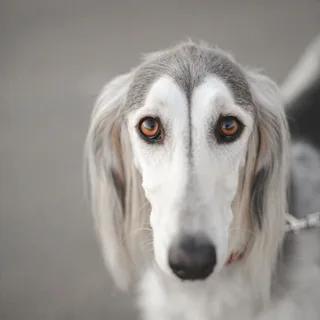
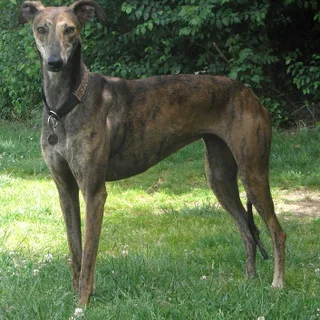
The Borzoi has a tall, lean, elongated and harmonious silhouette, with a solid bone structure without heaviness and a deep chest descending to the elbows. Its long and narrow head, with an almost absent stop, is extended by a fine muzzle. Its almond-shaped eyes, well spaced, give it a gentle and attentive expression. The small fine ears are set high, while the long tail, set low, is carried in a sabre. Its medium-length coat, silky, light, shiny and often wavy becomes more abundant around the neck. Many coat colors are accepted, notably white, fawn, brindle or black associated with white, with the exception of blue and brown.
Temperament
Temperament and personality
Very calm, balanced and sensitive in his home, the Borzoi willingly observes his environment before acting. He forms a close relationship with his owner and appreciates a respectful presence, without brusqueness. His behavior changes markedly when a movement triggers his pursuit instinct: he then becomes fast, impetuous and determined. Rather reserved than demonstrative, he can be stubborn and is not always very playful with children. Early socialization helps develop serene relationships with strangers and other animals, without making his hunting instinct disappear.
Living together
Living with children and animals
On a daily basis, the Borzoi knows how to remain discreet and calm indoors as long as its exercise needs are met. It needs regular outings and above all opportunities to run at high speed in a large, secure and fully enclosed area. Its chasing instinct requires caution near roads and around small animals. A house with a fenced garden suits it particularly well, but apartment living remains possible for a very available owner who organizes daily walks and suitable exercise sessions.
Training
Training and socialization
The Barzoi’s training must begin early, with consistent rules, great gentleness and short sessions that preserve its motivation. Intelligent but independent and sensitive, it responds poorly to harsh or repetitive methods. Recall must be worked on as a priority, while keeping in mind that it can become difficult to obtain when a trail or prey captures its attention. The long line, reward and gradual progression in fenced areas are essential tools. Socialization must include people, dogs, varied environments and, if necessary, the other animals in the household.
Budget
Borzoi price & budget
The price of a Barzoï depends on the quality of the line, the pedigree, the reputation of the breeding kennel, the screenings carried out on the breeding dogs and the dog's intended purpose, companion, show or breeding. The maintenance budget is that of a large dog and must include quality food as well as preventive veterinary follow-up.
View cost breakdownHealth
Health at a glance
The Borzoi is generally robust, but its large size, deep chest and sighthound morphology call for targeted monitoring. Quality nutrition, a stable weight, well-adjusted activity during growth and regular veterinary follow-up help to limit joint, digestive and ocular risks.
Prevention & watch pointsDiet
Feed it well
The Borzoi is not always a big eater, but it needs a complete, digestible diet adapted to its size. Protein quality, mineral balance and control of energy intake are particularly important during growth.
Our feeding adviceDid you know?
Anecdotes and popularity
The name Borzoi comes from a Russian term evoking speed. This sighthound can exceed 55 km/h at peak speed. It was closely linked to the Russian aristocracy and several tsars, including Ivan the Terrible, Peter the Great and Nicholas II, owned them. Writers such as Pushkin and Turgenev also contributed to its cultural renown. The breed is also known under the names Russian Wolfhound and Russkaya Psovaya Borzaya.