Origins
Where does it come from?
The origins of the Greyhound seem to date back to Antiquity, probably in Ancient Egypt and then in Greece. The breed was then developed in Great Britain, where this sighthound was long appreciated for hare coursing and hunting by sight. Its exceptional speed also made it famous on racetracks. The FCI definitively recognized the breed in 1955.
Appearance
What does it look like?
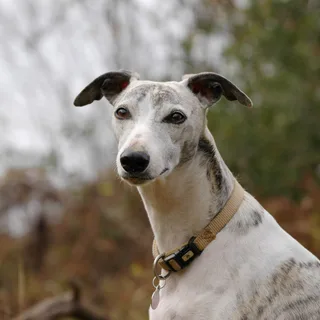
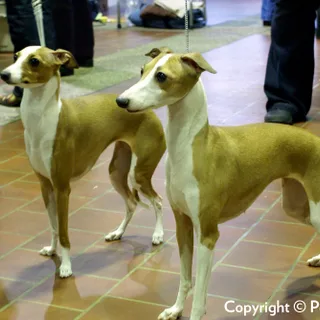
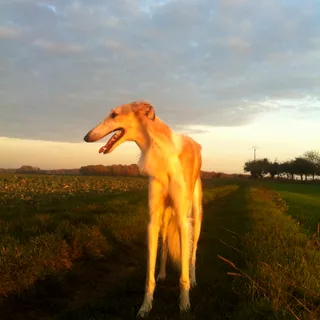
The Greyhound is a large, harmonious dog, built for speed, with powerful but lean musculature and a very slender silhouette. Its head is fine and long, the skull rather flat, the eyes oval and expressive, the ears small and rose-shaped and the tail long carried low. Its back is fairly long, the loin powerful and slightly arched, the chest deep and the flanks well tucked up. The coat is short, fine and close, with varied colors such as fawn, black, white, blue, red or brindle.
Temperament
Temperament and personality
The Greyhound is one of the calmest dogs among the large breeds. Gentle, loyal, sensitive and affectionate, it appreciates being close to its family while remaining discreet at home. It is generally not very aggressive and not much of a guard dog. Its chasing instinct nevertheless remains pronounced, which requires caution in the presence of small animals and during walks without a long lead.
Living together
Living with children and animals
At home, the Greyhound is often calm, quiet and capable of long periods of rest. Outside, on the contrary, it reveals a strong need to run and can produce very fast sprints. It generally prefers a house with a fenced garden, even if it readily lives in close contact with its family indoors. Serious socialization promotes good relationships with children and other animals.
Training
Training and socialization
The Greyhound is intelligent and its training is generally accessible, provided you act with gentleness, consistency and calm firmness. It is a sensitive dog that responds poorly to a show of force. Recall requires serious work due to its hunting and chasing instinct. Short, positive and regular sessions generally give the best results.
Budget
Greyhound price & budget
The purchase price of the Greyhound varies depending on the origin of the bloodline, the reputation of the breeding kennel, compliance with the standard and the quality of the follow-up offered. The maintenance cost must also be taken into account before adoption, notably for food, bedding, protection against the cold and veterinary follow-up.
View cost breakdownHealth
Health at a glance
The Greyhound has overall rather good health, but its sprinter morphology requires a few targeted precautions. Its very short coat protects it poorly from cold and bad weather. During intense efforts, it can also injure itself more easily in the limbs and extremities if the environment is not suitable.
Prevention & watch pointsDiet
Feed it well
The Greyhound's diet must support lean musculature, good recovery and the metabolism of a large active sighthound. It benefits from being stable, highly digestible and adapted to its age, its weight and its actual level of exercise.
Our feeding adviceDid you know?
Anecdotes and popularity
The Greyhound can reach around 70 to 72 km/h, which makes it one of the fastest dogs in the world and one of the swiftest land animals. Behind this spectacular top speed, however, lies a companion that is often very calm in everyday life, hence its reputation as a great athlete capable of also being a true couch dog.