Origins
Where does it come from?
The American Akita shares its origins with the Japanese Akita, whose ancestors lived in Akita Prefecture, in the north of the island of Honshu. Some of these dogs were crossed with Mastiffs and Tosas at the time of dog fighting, banned in Japan in 1908. During the Second World War, the breed narrowly avoided extinction and crosses with the German Shepherd were carried out to circumvent requisitions. After the war, American servicemen were won over by dogs of the Dewa line and imported them to the United States. American selection then favored more massive subjects, distinct from the Japanese type. The Akita Club of America was founded in 1956, the American Kennel Club recognized the breed in 1972 and the Fédération Cynologique Internationale recognized it on May 30, 1999.
Appearance
What does it look like?
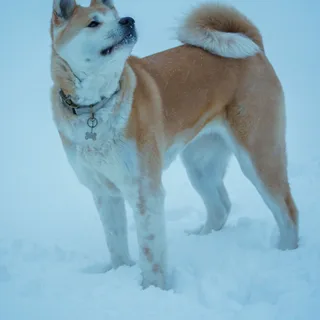
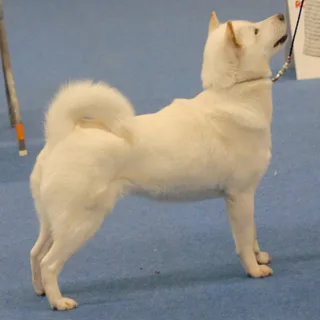
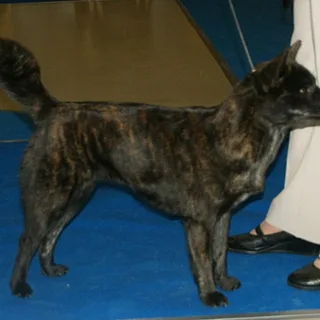
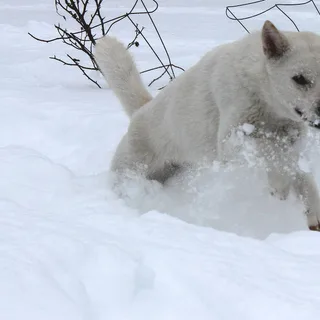
The American Akita is a large dog, powerful, balanced and with a heavy bone structure. Its body, slightly longer than tall, has a level back, a muscular loin and a broad, deep chest. Its massive head forms a blunt triangle, with a broad skull, a pronounced stop, a black nose and small dark brown almost triangular eyes. The ears, small and triangular, are erect. The thick tail, set high, is carried curled over the back or the flank. The outer coat is straight, harsh and slightly standing off, combined with a short, soft and very dense undercoat. Red, fawn, white, brindle and piebald coats are accepted.
Temperament
Temperament and personality
Calm, dignified and self-assured, the American Akita is deeply loyal to its family and has a very strong protective instinct. It remains reserved and wary with strangers, without being unnecessarily barky. Its independent and decisive temperament requires a relationship based on trust. It may seek confrontation with other dogs, especially those of the same sex, and its low tolerance threshold calls for serious socialization. With children, its power and its sometimes strict reading of clumsy gestures make close supervision essential; it is better suited to respectful teenagers than to very young children.
Living together
Living with children and animals
At home, he appreciates being close to his family as much as periods of calm and does not cope well with prolonged solitude. He is not an endurance athlete, but must benefit from several daily outings, exploration and mental activities in order to maintain his musculature and limit weight gain. A large, securely fenced garden suits him, without replacing walks. Apartment living remains possible with a very available owner, but it is less suited to his size and his needs. Encounters with other dogs must be managed with caution, particularly between dogs of the same sex.
Training
Training and socialization
His training must begin as soon as he arrives in the home and continue throughout his life. Early, gradual and controlled socialization is essential with regard to people, environments, handling and other animals. Intelligent but not very inclined toward mechanical obedience, he learns best during short, consistent and motivating sessions. Positive reinforcement, play and stable rules should be favored. Harsh or coercive methods should be avoided, as they damage trust and can intensify defensive reactions. Recall, leash walking, giving up and acceptance of care are priorities.
Budget
American Akita price & budget
The purchase price varies depending on the lineage, the quality of the pedigree, the health results of the breeding dogs, the reputation of the kennel and the puppy’s intended purpose. The budget must also include the feeding of a large dog, veterinary care, insurance, training and suitable equipment.
View cost breakdownHealth
Health at a glance
Robust and well protected by its double coat, the American Akita can nevertheless be predisposed to several joint, dermatological, endocrine and ocular conditions. Rigorous selection of breeding dogs, regular veterinary monitoring, controlled growth and maintaining an optimal weight contribute greatly to preserving its health.
Prevention & watch pointsDiet
Feed it well
The American Akita needs a complete, balanced diet adapted to its age, its weight, its sterilization and its activity level. During growth, controlling energy intake and mineral balance is essential to support its development without excessively accelerating weight gain.
Our feeding adviceDid you know?
Anecdotes and popularity
The American Akita was long called Great Japanese dog in the international nomenclature. Its silhouette differs from that of the Akita Inu by a more massive build, a broader head and the acceptance of all colors, including the black mask and piebald coats. Despite its imposing appearance, it is generally not very noisy and prefers silent vigilance to repeated barking.