Origins
Where does it come from?
The Akita Inu is a Japanese breed originating from Akita Province. From the 17th century, its ancestors, called Akita Matagis, were used for hunting big game and fighting. In the 19th century, the breed underwent crossbreeding with the Tosa and the Mastiff before being gradually restored. After the ban on fighting in 1908, selective breeding work helped preserve its type. Designated a Historic Monument in Japan in 1931, the Akita Inu nearly disappeared during World War II before being saved by passionate breeders. The FCI recognized the breed in 1964.
Appearance
What does it look like?
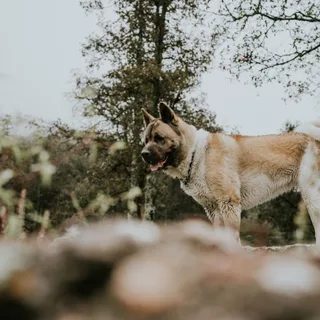
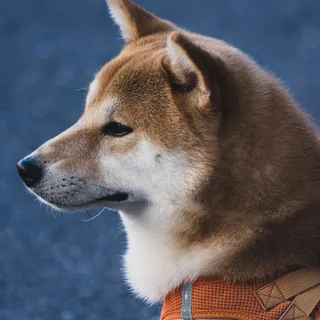
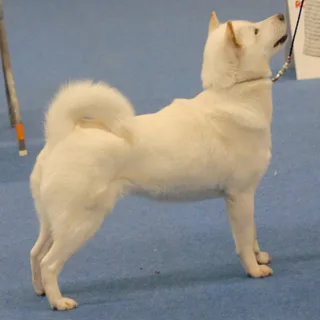
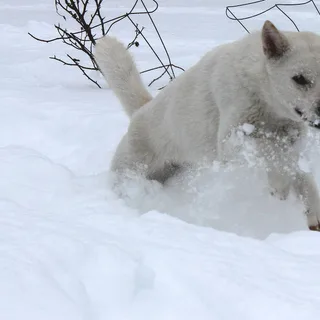
The Akita Inu is a large Spitz-type dog, sturdy, compact and well proportioned. Its body is powerful, with pronounced musculature, a straight and solid back, and a thick tail carried curled over the back. Its broad head, its small triangular ears erect and pointing forward, and its dark almond-shaped eyes give it an expression that is both calm and alert. Its outer coat is fairly short and harsh, with a dense undercoat that protects it well from cold and bad weather.
Temperament
Temperament and personality
Calm, very attached to his family circle and naturally dignified, the Akita Inu is affectionate with his own while remaining wary of strangers. His independent temperament and strong character require a consistent owner. Well socialized, he can be patient with children, but he is not always spontaneous with other animals.
Living together
Living with children and animals
On a daily basis, the Akita Inu is a calm, discreet dog and relatively not very barky. It can live just as well in a house as in an apartment if its outings are regular and if its need for stability is respected. It likes to observe its environment, stay close to its family and alternate calm moments and moderate walks.
Training
Training and socialization
The Akita Inu needs early, firm, fair and consistent training. Its intelligence is real, but its independence can make it less cooperative than a dog that is naturally very obedient. The relationship of trust with its owner is essential, as is careful socialization from the youngest age to limit distrust and tensions with its fellow dogs.
Budget
Akita Inu price & budget
The price of an Akita Inu varies mainly according to the quality of the lineage, the reputation of the breeding kennel, the health tests carried out and compliance with the standard. A well-selected puppy represents a significant initial investment, generally consistent with the breeding work required by the breed.
View cost breakdownHealth
Health at a glance
The Akita Inu is overall a robust breed, able to withstand varied climatic conditions well, especially the cold. Like many selected breeds, it nevertheless has a few hereditary predispositions that justify careful veterinary monitoring and a rigorous choice of breeder.
Prevention & watch pointsDiet
Feed it well
The Akita Inu can be selective about food and sometimes does not tolerate certain formulas rich in cereals well. Its diet must remain of good quality, digestible and adapted to its age, its size and its activity level.
Our feeding adviceDid you know?
Anecdotes and popularity
The Akita Inu is worldwide associated with Hachiko, a dog that became a symbol of loyalty in Japan for having waited every day for his missing master at Shibuya Station for years. His story inspired several works, a statue that became famous in Tokyo and a film adaptation.