Origins
Where does it come from?
The Kishu originates from the mountainous regions of Kishu, straddling the prefectures of Wakayama and Mie in Japan. An ancient deer hunting dog, it was then mainly selected for wild boar hunting. The breed was declared a Natural Monument in 1934, then definitively recognized by the Fédération Cynologique Internationale on 1 February 1982.
Appearance
What does it look like?
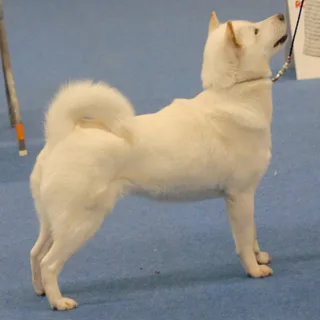
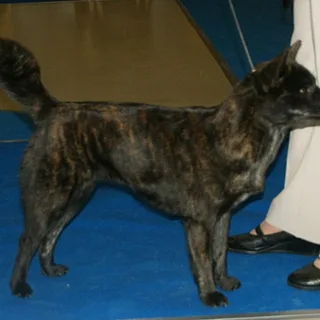
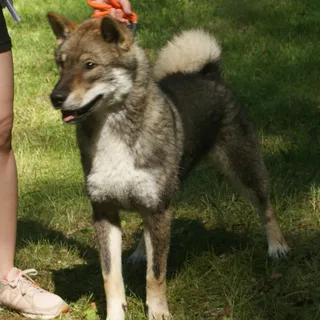
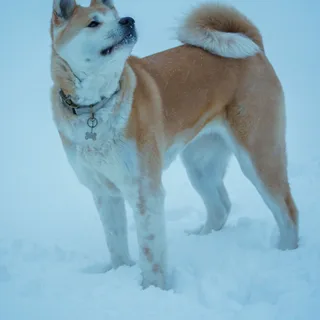
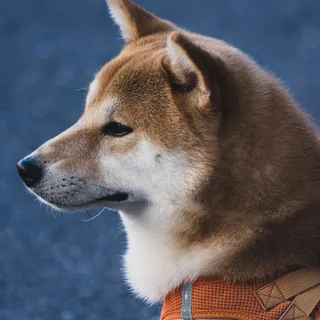
The Kishu is a medium-sized dog, robust, compact and well proportioned. Its head is rather square in shape, with a broad forehead, a thick muzzle and strong jaws. Its small triangular ears are well erect and slightly inclined forward. Its tail, set high, is carried in a sickle shape or curled. The coat is short, straight and harsh, with a soft and dense undercoat. The coat color can be white, sesame or red.
Temperament
Temperament and personality
The Kishu is an alert, energetic, docile and calm dog at the same time. Hardy, faithful and loyal, it develops a strong attachment to its owner. Its sober and attentive temperament makes it a pleasant companion, but its hunting dog background keeps a certain independence and a marked instinct.
Living together
Living with children and animals
On a daily basis, the Kishu is calm indoors if it gets enough exercise, but it remains an active dog that needs regular outings. It can live in an apartment with 3 to 4 walks per day, even if it clearly prefers having access to a fenced outdoor space. It appreciates routine, physical activity and a stable environment.
Training
Training and socialization
The Kishu’s training must start early, with an approach that is both gentle, consistent and firm, without a power struggle. Its sensitivity and independence require a calm owner, able to establish clear boundaries and to work on socialization from the youngest age. Consistency gives better results than coercion.
Budget
Kishu price & budget
The Kishu remains a rare breed whose purchase price mainly reflects the rarity of litters, the selection of breeding dogs and the seriousness of the breeding. It is important to favor a breeder that is transparent about health, temperament and socialization.
View cost breakdownHealth
Health at a glance
The Kishu is generally a robust and resilient dog when it benefits from good hygiene habits, a suitable diet and regular activity. Its health profile is rather favorable for a breed of this size, but normal veterinary follow-up remains important.
Prevention & watch pointsDiet
Feed it well
The Kishu needs a complete and digestible diet, adapted to its age, its weight and its activity level. The quality of the ingredients and the regularity of meals matter more than an abundant ration.
Our feeding adviceDid you know?
Anecdotes and popularity
The Kishu is part of the traditional Japanese spitz-type breeds. Its noble silhouette, its elegant expression and its history as a mountain hunting dog make it a breed that is both rustic and refined. Solid-colored coats have been favored since the 1930s, which has made red or sesame individuals rarer.