Origins
Where does it come from?
The Spanish Alano is a very ancient catch dog from the Iberian Peninsula, used for driving cattle, hunting big game and formerly for war tasks. Decimated in the 20th century, it was rebuilt from rural subjects from northern Spain. It is not a show mastiff: the sought-after type remains functional, lean and mobile. In France, a few breeders maintain it among knowledgeable enthusiasts.
Appearance
What does it look like?
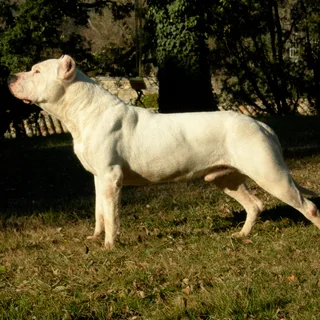
Atypical molosser, more long-limbed and taller on legs than a classic mastiff. The head is broad but dry, the muzzle fairly long, the lips less pendulous than in heavy mastiffs. The coat is short, fawn, brindle, black-masked or sable. The skin is fairly thick. The gait is supple, capable of acceleration.
Temperament
Temperament and personality
Serious, courageous, attached to his owner, not very demonstrative with strangers. He can live in a structured family if he was socialized early. With other animals, especially livestock or game, the instinct to seize exists. This is not a dog for an improvised walk.
Living together
Living with children and other pets
He needs exercise, clarity and an owner who takes responsibility. A fenced garden is a plus. An apartment is only conceivable for an adult already very well controlled. Without a framework, he gets bored and can become possessive.
Training
Training and socialization
Work on control, calmness and socialization from the youngest age. Bite sports must be reserved for professionals, often best avoided. Household consistency is more important than the number of commands learned.
Budget
Price and budget for the Spanish Alano
A Spanish Alano puppy is often between 1,000 and 1,800 euros. The seriousness of the breeding and sociability weigh more than the look.
See cost breakdownHealth
Health at a glance
Drier than many molossers, it avoids some of the respiratory excesses, but hips, stomach and skin still need monitoring. The reconstruction of the breed requires looking at the origins and the sociability of the parents.
Prevention and things to watch forNutrition
Feeding your pet well
The Spanish Alano needs a complete, digestible diet adjusted to its age, its activity and its body condition. Protein quality and control of energy intake matter as much as the size of the ration.
Our feeding adviceDid you know?
Fun facts and popularity
The name Alano refers to the dogs of the Alans, an ancient people whose molossers influenced Europe. It is distinguished from the Dogo Canario, heavier. In Spain, it remains a dog of rural tradition more than of fashion.