Origins
Where does it come from?
The Dogo Canario breed is said to have been obtained by crossing the Majorero, an old cattle dog originating from the Canary Islands, mainly Tenerife and Gran Canaria, with molossoid-type dogs brought to the archipelago by the Spaniards. Used as a guardian and driver of cattle herds, its numbers increased in the Canary Islands from the 16th and 17th centuries. The Fédération Cynologique Internationale recognized it on a provisional basis on 4 June 2001, then on a definitive basis on 4 July 2011.
Appearance
What does it look like?
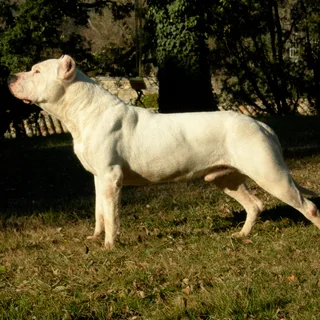
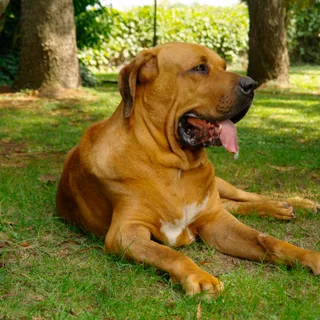
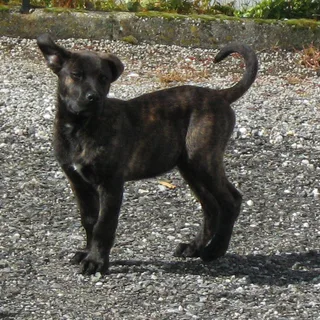
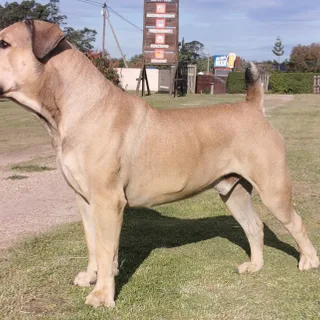
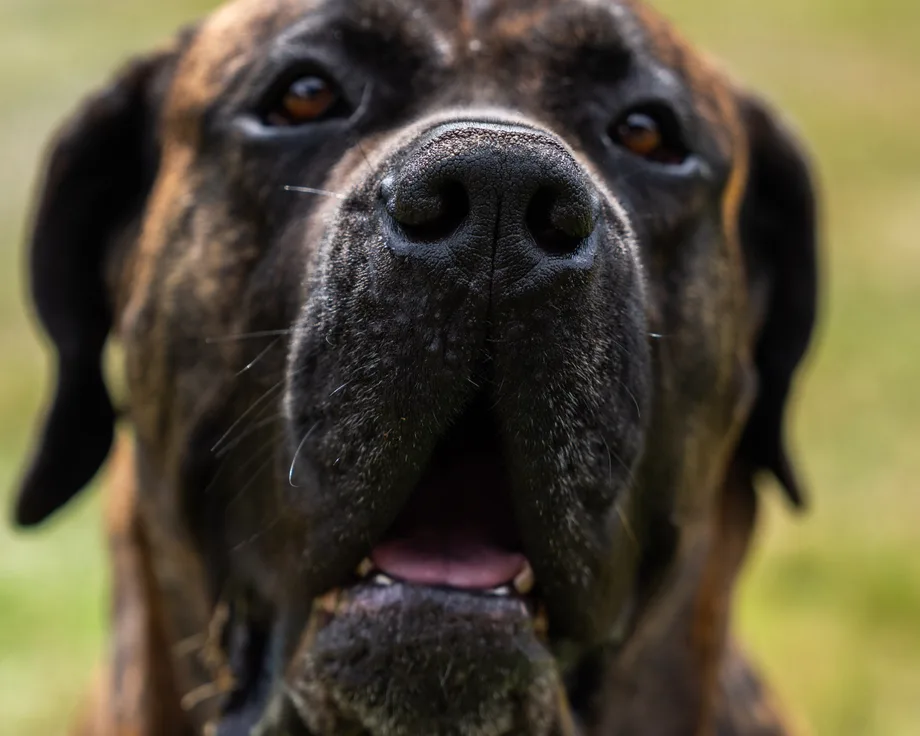
The Dogo Canario is a large molossoid dog, massive, well proportioned, with a developed bone structure and musculature. Its body fits into a rectangle, with a massive and muscular neck, a straight topline, a rounded croup, a broad chest and well arched ribs. Its massive, compact and brachycephalic head has a large black nose, powerful jaws and oval dark to medium brown eyes. Its ears are naturally drooping and its tail, thick at the base, tapers towards the tip. Its short, harsh and close-lying coat is almost devoid of undercoat. The coat is brindle or fawn in all shades, sometimes marked with white on the chest and at the base of the neck, with a mask always black. Despite its strong constitution, its movements remain agile and supple.
Temperament
Temperament and personality
Attentive, protective towards its owner and its family and naturally wary of strangers, the Dogo Canario has the qualities of a guard dog. Its temperament is balanced, calm and full of confidence. Its low and deep bark is a characteristic of the breed.
Living together
Living with children and other pets
Traditionally used for driving and guarding cattle herds, the Dogo Canario needs daily walks and exercise, without overly intensive activity in order to preserve its joints. It prefers to have a large fenced garden rather than live in an apartment. Its owner must be available to keep it occupied and prevent boredom.
Training
Training and socialization
The Dogo Canario must be trained with firmness from an early age in order to become an obedient and well-balanced dog. Any brutality must be excluded, as it could break him or make him aggressive. His training must combine firmness, gentleness and positive reinforcement.
Budget
Price and budget for the Canary Mastiff
The observed acquisition price varies within a narrow range.
See cost breakdownHealth
Health at a glance
The Dogo Canario is a rustic and particularly robust dog. Its single coat, almost devoid of undercoat, does not, however, protect it sufficiently from cold, bad weather and difficult climatic conditions. The breed also has predispositions to certain conditions that require veterinary monitoring.
Prevention and things to watch forNutrition
Feeding your pet well
The Dogo Canario has significant dietary needs, consistent with its large size and developed musculature. Its feeding budget must be anticipated before adoption.
Our feeding adviceDid you know?
Fun facts and popularity
The Dogo Canario is also called Dogue des Canaries, Perro de Presa Canario or Canary Mastiff. Its FCI standard bears number 346 and its definitive recognition dates from 2011.