Origins
Where does it come from?
The Norwegian, also called Norwegian Forest Cat or Skogkatt, is a natural breed resulting from selection by the Scandinavian climate rather than from a directed crossbreeding. In Norway, it is often associated with old farm cats and folk tales, and its hardiness is said to have favored its presence alongside the Vikings. The breed began to be shown in the 20th century, then was truly preserved and developed from the 1970s after nearly disappearing due to the effects of uncontrolled crossbreeding.
Appearance
What does it look like?
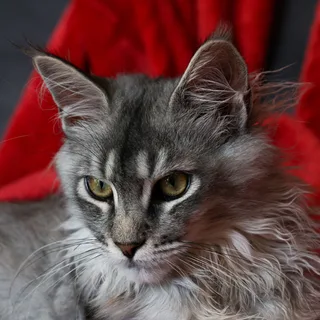
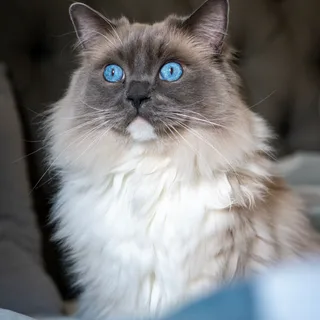
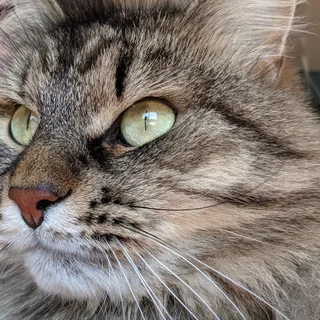
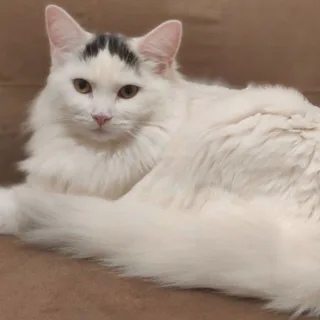
The Norwegian is a large, powerful and well-built cat, without excessive heaviness. Its body is long and muscular, with a solid bone structure and an overall impression of strength. The head forms a balanced triangle, the eyes are large and expressive, the ears are high with a tuft often visible, and the tail is long and very bushy. Its semi-long to long coat has a woolly undercoat and a pronounced ruff, particularly useful for withstanding the cold.
Temperament
Temperament and personality
Under its wild cat appearance, the Norwegian shows itself to be calm, affectionate and well-balanced. It creates a strong bond with its family while keeping a certain independence. It is an intelligent, observant and generally patient cat, which appreciates chosen interactions rather than constant solicitation. It often lives well with respectful children and with other animals when it is properly socialized.
Living together
Living with children and animals
The Norwegian loves to climb, explore and watch over its environment from high points. Even if it can live indoors, it needs daily occupation, play and an enriched setup with a cat tree, platforms or hiding places. Its hunter instinct remains very present and it appreciates activities that stimulate its curiosity. It vocalizes moderately and often tolerates cold better than heat.
Training
Training and socialization
The education of the Norwegian is based on regularity, environmental enrichment and positive reinforcement. He easily learns household routines, the use of scratching posts and certain interactive games if the sessions remain short and motivating. Like many intelligent cats, he responds better to a gentle and consistent approach than to constraint. Early socialization promotes harmonious cohabitation with humans and other animals.
Budget
Norwegian Forest Cat price & budget
The price of a Norwegian varies mainly according to the quality of the lineage, the seriousness of the breeding, the health tests carried out, registration in the official studbook and the kitten’s intended purpose, pet or breeding. An abnormally low price should always prompt you to check the breeding conditions and the health guarantees.
View cost breakdownHealth
Health at a glance
The Norwegian is overall a robust cat, shaped by a long adaptation to demanding climatic conditions. This sturdiness does not rule out serious veterinary monitoring, particularly in breeding cats and in lines where certain hereditary conditions are monitored. A stable lifestyle, a controlled weight and regular coat maintenance contribute greatly to its good health.
Prevention & watch pointsDiet
Feed it well
The Norwegian needs a complete diet, rich in quality animal proteins and adapted to its age, its activity and its physiological status. Its ration must support its muscle mass without promoting weight gain, particularly in individuals living mainly indoors.
Our feeding adviceDid you know?
Anecdotes and popularity
The Norwegian is often nicknamed Skogkatt, which means forest cat. Its powerful silhouette, its protective coat and its ears sometimes with lynx tips feed its image as a legendary Nordic cat. Although it evokes a wild feline, it has established itself as an excellent companion cat, appreciated for its rare blend of hardiness, gentleness and autonomy.