Origins
Where does it come from?
The Turkish Van is an ancient breed originating from Turkey, associated with the Lake Van region and Mount Ararat. Ancient depictions suggest that this cat has been present for millennia. Its introduction to Europe dates mainly to the 1950s, when Laura Lushington and Sonia Halliday made it known in the United Kingdom. The breed remains today quite rare in France and still not very widespread compared with other companion cats.
Appearance
What does it look like?
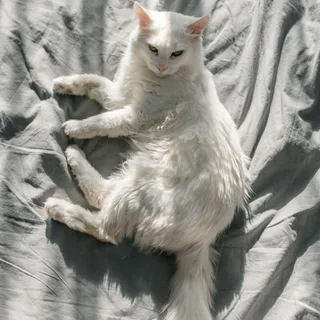
The Turkish Van is a powerful and elegant cat, with a long and muscular body, with rather slow growth. Its head forms a softened triangle, the ears are medium-sized and set high, and the eyes, large and expressive, can be amber, blue or odd-eyed. Its coat is semi-long, soft and dense, with very little undercoat, often mostly white with colored markings on the head and tail.
Temperament
Temperament and personality
The Turkish Van is an intelligent, demonstrative, playful and affectionate cat. It retains a real independence but readily seeks the presence of its human and appreciates signs of attention. Sociable with its family, it can live just as well with children as with other animals when it is properly socialized.
Living together
Living with children and animals
Active without being nervous, the Turkish Van likes to explore, play and stay stimulated on a daily basis. It does not tolerate boredom well and appreciates enriched environments with cat trees, hiding places and toys. Its best-known characteristic is its attraction to water, a rather rare trait in cats, which explains its nickname of swimming cat.
Training
Training and socialization
The Turkish Van responds well to gentle, consistent and regular training. Its keen intelligence allows it to quickly learn routines, the use of interactive games and sometimes even to fetch objects. Positive reinforcement should be favored and activities varied to maintain its motivation.
Budget
Turkish Van price & budget
The Turkish Van is a rare breed, which directly influences its purchase price. The cost varies mainly depending on the quality of the lineage, the seriousness of the breeding, conformity to the standard, and the availability of kittens.
View cost breakdownHealth
Health at a glance
The Turkish Van is generally a robust cat, with a good life expectancy and few particular daily requirements. As with any breed, regular prevention, an appropriate diet and constant veterinary follow-up remain essential to maintain its physical condition and to detect potential problems early.
Prevention & watch pointsDiet
Feed it well
The Turkish Van has no specific dietary requirements, but its diet must be of good quality and suited to its age, activity level, health status and body condition. A well-balanced ration helps maintain its musculature and vitality.
Our feeding adviceDid you know?
Anecdotes and popularity
The Turkish Van is often confused with the Turkish Angora, although they are two distinct breeds. It is also nicknamed the Turkish cat of Lake Van or the swimming cat because of its unusual attraction to water. Its predominantly white coat with limited colored markings is among its most recognizable traits.