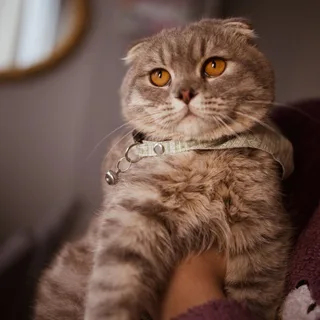
Longevity
Life expectancy
With attentive care, a suitable diet and good medical follow-up, the Highland Fold can live from 11 to 15 years. Longevity depends on the quality of the breeding, lifestyle and hereditary predispositions.
Build
A robust breed?
Less hardy than a European cat. The long coat and the joints require monitoring. Well-bred individuals, from only one fold parent, and closely monitored nevertheless live many good years indoors.
Watch points
What to watch for
Slightly flexible tail, stiff gait, reluctance to jump, watery eyes, noisy breathing, excessive thirst. Any stiffness warrants prompt veterinary advice.
Osteochondrodysplasia : The folded-ear gene can stiffen the tail and joints and cause chronic pain.
Sensitive eyes : The round head promotes tearing and irritation.
Respiratory comfort : Over-typed lines may breathe less well, especially in hot weather.
Kidneys : Depending on Persian contributions, kidney monitoring may be relevant.
Climate
Cold and heat tolerance
Indoor cat. The long coat bothers him in high heat. In winter, he likes radiators, without burning himself on them. No free roaming where there is traffic.
Weight
Tendency to gain weight
The Highland Fold must maintain a silhouette suited to its morphology, with palpable ribs without excess. The ration must follow the actual activity, age and sterilization. Regular weighing prevents overly significant variations.
Daily life
Good habits to keep it healthy
- Palpate the tail regularly and observe the suppleness of the gait.
- Brush often to limit knots and hairballs.
- Avoid repeated jumps if stiffness appears.
- Never buy a kitten from two fold parents.
Vaccination
Highland Fold vaccines: vaccination schedule
Which vaccines for a Highland Fold? Like all dogs, the Highland Fold receives essential vaccines from 8 weeks old: CHPPi (core vaccine) and Leptospirosis. The puppy primary vaccination for Highland Fold is given in several injections 4 weeks apart, followed by a first booster at 1 year. Depending on its lifestyle (hunting, hiking, boarding, travel, region), your veterinarian may complete the protocol with vaccines against Rabies, Kennel cough, Piroplasmosis, Lyme disease and Leishmaniasis.
| Vaccine | Primary series | First booster | Then | Who for? |
|---|---|---|---|---|
CHPPi (core vaccine)Core Distemper, Rubarth hepatitis, parvovirosis and parainfluenza | 8 weeks · 12 weeks · 3 months | 1 year | every year | All pets |
LeptospirosisCore Leptospirosis (bacterium transmitted by rodent urine and stagnant water) | 8 weeks · 12 weeks | 1 year | every year | All pets |
RabiesLifestyle-based Rabies | 12 weeks | 1 year | every year | Mandatory for travel abroad, categorized dogs, most boarding kennels and shows |
Kennel coughLifestyle-based Bordetella bronchiseptica and parainfluenza | 8 weeks | 1 year | every year | Dogs attending boarding kennels, daycares, dog clubs and shows |
PiroplasmosisLifestyle-based Tick-borne babesiosis | 5 months · 6 months | 1 year | every year | Hunting dogs, dogs living in rural or wooded areas, dogs highly exposed to ticks |
Lyme diseaseLifestyle-based Tick-borne borreliosis | 12 weeks · 3 months | 1 year | every year | Hiking dogs, hunting dogs, forest areas of the East and the Center |
LeishmaniasisLifestyle-based Leishmaniasis transmitted by sandflies | 6 months | 1 year and 6 months | every year | Dogs living or staying in the South of France, Corsica and the Mediterranean basin |
Adult Highland Fold vaccine boosters are annual for leptospirosis and rabies; for distemper, hepatitis, and parvovirus, a booster every three years is often sufficient after the first booster. Your veterinarian will adjust the schedule to your dog’s actual risk.
Which boosters for your Highland Fold?
Enter your companion’s age: we list the vaccines to do now and the next boosters.
Adopting well
Adopting a healthy Highland Fold
Joint monitoring, kidneys, eyes, breathing. Never cross fold × fold. Ask for the origins and the breeding policy in writing.
This information is provided for guidance only and does not replace a veterinarian’s advice. If you have any concerns about your pet’s health, consult a professional.