Origins
Where does it come from?
The Scottish Fold appeared in 1961 in Scotland, when a cat with naturally folded ears was noticed near Coupar Angus, in the Tayside region. From this characteristic due to a spontaneous genetic mutation, William Ross and his wife Mary developed the breed, notably through crosses with the British Shorthair. The semi-longhaired variety is called Highland Fold. The breed then gained popularity, especially in the United States, where it was registered in championship by the CFA in 1978, before arriving in France in the following decade. Its breeding nevertheless remains debated because of the health problems linked to the mutation responsible for the folded ears.
Appearance
What does it look like?
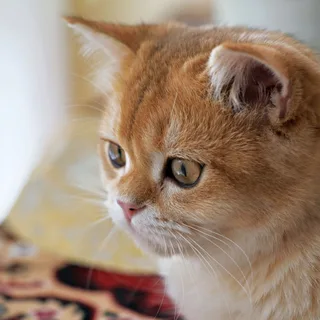
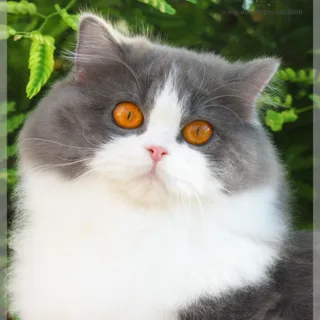
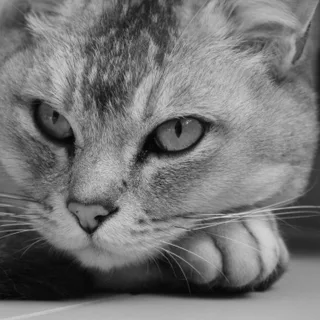
The Scottish Fold is a medium-sized cat, with a broad, stocky and well-muscled body. Its head is round, with full cheeks, a rather short nose and large round eyes with a gentle expression. Its best-known characteristic is the presence of small ears folded forward, wide at the base and rounded at the tip. The legs are relatively short without hindering movement, the tail is flexible and of medium length, and the coat is short, dense, with a thick undercoat.
Temperament
Temperament and personality
The Scottish Fold is appreciated for its calm, gentle and affectionate temperament. It readily seeks the company of its family, shows tenderness toward its humans and generally remains discreet in its vocalizations. Behind its apparent tranquility, it retains a playful and curious side that allows it to share well in the daily life of an active household, provided that the environment remains reassuring and stable.
Living together
Living with children and animals
This cat adapts easily to different living environments, including apartments, and copes quite well with the presence of children as well as other animals. It likes to watch, play and explore without being particularly prone to wandering off. On the other hand, it tolerates long periods of solitude poorly and can be disturbed by changes that are too frequent in its habits.
Training
Training and socialization
The education of the Scottish Fold is based mainly on gentleness, consistency and enrichment of the living environment. He understands routines well, responds favorably to calm encouragement and easily learns to use scratching posts, resting areas and everyday rituals. It is better to avoid any harsh constraint, because this sensitive cat prefers a stable and predictable framework.
Budget
Scottish Fold price & budget
The price of the Scottish Fold varies depending on the lineage, compliance with the standard, the reputation of the breeding cattery and the seriousness of health monitoring. Vigilance is essential, because the breed’s typical appearance must never take precedence over health and breeding conditions.
View cost breakdownHealth
Health at a glance
The Scottish Fold generally has a solid constitution, but its breed requires particular vigilance due to the mutation linked to folded ears. This characteristic may be accompanied by cartilage and skeletal disorders whose severity varies depending on the individuals. Serious veterinary monitoring and the choice of a responsible breeder are essential.
Prevention & watch pointsDiet
Feed it well
The Scottish Fold needs a complete, balanced diet adapted to its age, activity level and physiological status. Its possible tendency to greediness justifies a measured ration, given consistently and accompanied by permanent access to fresh water.
Our feeding adviceDid you know?
Anecdotes and popularity
All Scottish Fold kittens are born with straight ears, which only begin to fold from the age of 3 to 4 weeks in individuals carrying the sought-after trait. Individuals from the same line that keep straight ears are called Scottish Straight, while the semi-longhaired variety is known as Highland Fold. The breed still raises ethical debates today because of the link between its iconic appearance and certain osteoarticular disorders.