Origins
Where does it come from?
The Chausie is a hybrid breed born from the crossing between a domestic cat and the Chaus, Felis chaus, a feline associated with ancient Egypt and depicted on pharaohs' tombs. The modern breed appears during the second half of the 20th century, notably in North America and in Southeast Asia. Abyssinians also took part in its creation. Breeders were looking for a cat with an exotic appearance, but with a gentler and more docile temperament. The LOOF has recognized the Chausie since 2003.
Appearance
What does it look like?
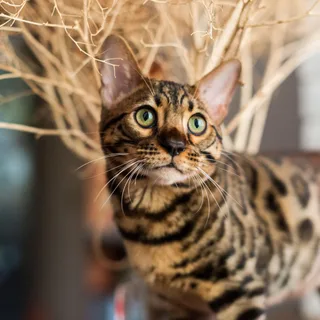
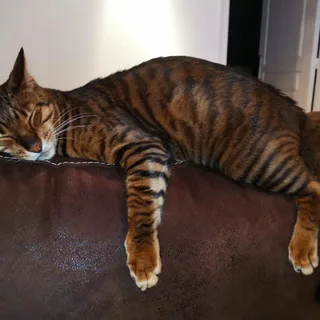
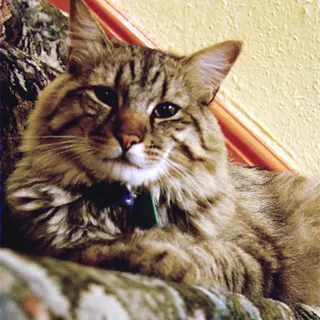
The Chausie has a long, powerful, slender and muscular body, carried by long and sturdy legs suited to running and jumping. Its triangular and elongated head, with prominent cheekbones, a strong chin and a rounded muzzle, evokes a small puma. Its large ears, wide at the base and slightly rounded, may bear a small tuft of hair. Its wide eyes, walnut-shaped or oval, range from gold to yellow, with light green and hazel also accepted depending on the coat. Its relatively short tail reaches at most the hock. The coat, short to semi-long, silky and close to the body, shows a pronounced ticking. The accepted colors are solid black, brown ticked tabby and black silver tipped.
Temperament
Temperament and personality
Despite its wild origins, the Chausie has become a sociable, gentle and docile cat. Very intelligent, playful, active and athletic, it enjoys cuddles and seeks a lot of attention from its owner. It does not tolerate solitude well and can be stubborn or nonchalant if it feels neglected. It readily cohabits with other cats and other animals, but its strength and impulsiveness require supervision around babies and very young children.
Living together
Living with children and animals
The Chausie needs space, activity and many opportunities to climb. A large house, ideally with a secure garden, suits its adventurous temperament better than a small apartment. It readily explores its environment and may look for prey outside. Fragile objects should be placed out of its play area. Its family must be available and devote time to it every day.
Training
Training and socialization
Its education must begin early, with patience, consistency and gentleness. In particular, it is necessary to teach it to control its claws, offer it activities suited to its intelligence and channel its energy without confrontation. Its owner must know feline needs or be ready to learn quickly, because the Chausie demands time and is not the simplest choice for a novice.
Budget
Chausie price & budget
The purchase price varies depending on the cattery, the lineage, the hybrid generation, the pedigree and the cat's conformity to the standard. The annual maintenance budget indicated by the source is between 300 and 500 euros.
View cost breakdownHealth
Health at a glance
The Chausie is generally robust, but it may have digestive sensitivity and food allergies, notably to gluten in some individuals. Progressive retinal atrophy is also reported. Regular veterinary visits and appropriate vaccination prevention remain essential.
Prevention & watch pointsDiet
Feed it well
The Chausie may poorly tolerate certain industrial foods containing cereals. A high-quality diet, rich in proteins and well adapted to its digestive sensitivity should be preferred, with careful monitoring of its individual tolerance.
Our feeding adviceDid you know?
Anecdotes and popularity
The Chausie owes its name to the Chaus, or Felis chaus, one of its wild ancestors. Its appearance as a small wild feline contrasts with a temperament that has become sociable and affectionate over the course of selective breeding. The LOOF has recognized the breed since 2003.