Origins
Where does it come from?
The Ocicat is a breed created in the United States in the 1960s from crosses involving in particular the Abyssinian, the Siamese and the American Shorthair. The initial goal was not to reproduce a wild feline, but to obtain a domestic cat with an original spotted pattern. The breed was then stabilized to preserve its exotic appearance while keeping a familiar and balanced temperament.
Appearance
What does it look like?
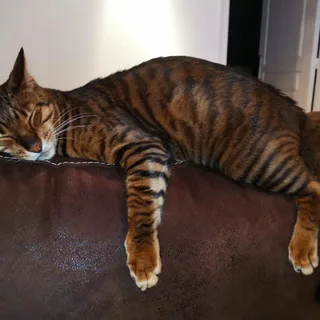
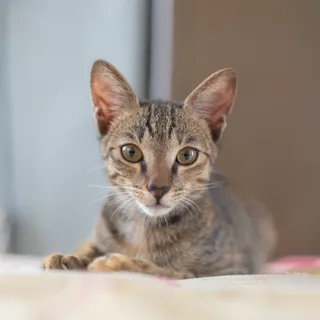
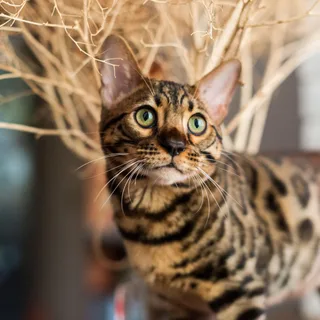
The Ocicat is a medium to large cat, solidly muscled, elegant and athletic. Its body is elongated without heaviness, its chest is well developed and its bone structure remains harmonious. Its short, smooth and glossy coat highlights well-distributed spots, while its slightly triangular head, open ears and expressive eyes reinforce its alert appearance.
Temperament
Temperament and personality
The Ocicat is known for its sociable, curious and active temperament. It readily seeks human company, takes part in household life and generally copes well with a lively family life. Intelligent and observant, it enjoys interactions, games and varied stimulation.
Living together
Living with children and animals
On a daily basis, the Ocicat is a present, playful and often demonstrative cat. He likes to explore his environment, climb, follow his humans from one room to another and take an interest in what is happening around him. Well socialized, he often cohabits properly with other cats and with calm dogs, provided that introductions are gradual.
Training
Training and socialization
The education of the Ocicat is based on consistency, environmental enrichment and positive reinforcement. This cat quickly understands routines, can learn certain small exercises and adapts well to clear rules if they are set early. To avoid boredom, it is useful to offer it intelligence games, elevated courses and daily interaction sessions.
Budget
Ocicat price & budget
The price of an Ocicat depends mainly on the rarity of the breed, the quality of the bloodlines, the seriousness of the breeding and the intended purpose of the kitten. Cats resulting from rigorous selection work and properly socialized are generally in the upper part of the market.
View cost breakdownHealth
Health at a glance
The Ocicat is considered a generally robust breed when it comes from a reputable breeder who monitors the breeding cats. As with other breeds from selected lines, monitoring family history and regular veterinary follow-up remain important to maintain good health over the long term.
Prevention & watch pointsDiet
Feed it well
The Ocicat needs a complete and balanced diet, adapted to its age, its activity level and its physiological status. Good quality food helps support its muscle mass, its energy and the condition of its skin as well as its coat.
Our feeding adviceDid you know?
Anecdotes and popularity
Despite its appearance as a small wild feline, the Ocicat is a fully domestic cat, with no recent hybridization with a wild species. Its name refers to the ocelot because of its spotted coat, but its temperament is generally much easier to live with than its exotic look might suggest.