Origins
Where does it come from?
The American Bobtail is a recent breed developed in the United States from the mid-1960s. Its history is associated with Yodi, a brown tabby cat with a short tail discovered on an Indian reservation in Arizona by John and Brenda Sanders, then mated with a long-tailed female cat. Several kittens in the litter inherited a short tail. Mindy Shultz then took part in the development and recognition of this new breed, obtained in 1989. Despite its name and its build, the American Bobtail does not descend from the Japanese Bobtail and remains still relatively rare in Europe.
Appearance
What does it look like?
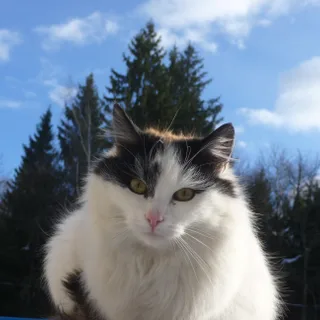
Medium to large in size, the American Bobtail has a semi-cobby body, muscular, athletic and slightly longer than tall, with a full chest and strong hips. Males are generally more powerful than females. The head is broad, without flat surfaces, with visible jaws, full cheeks, a strong chin, a slightly curved nose and a slight stop. The ears, medium and wide at the base, are open, set fairly low and slightly rounded, sometimes ending in tufts. The large oval eyes are set at an angle and their color often matches the coat. The tail, an essential characteristic of the breed, measures about 2 to 10 cm and never extends beyond the tip of the hock. There is a short-haired variety and another semi-long-haired one. The coat is dense, shaggy and fuller at the ruff, belly, hindquarters and around the tail; the semi-long variety may have tufts between the toes. All colors and all coat patterns are accepted.
Temperament
Temperament and personality
Behind its wild appearance, the American Bobtail is a very gentle, demonstrative cat, and deeply attached to its home. Often described as a "cat-dog", it readily seeks the closeness of its humans and can be very present. Playful and curious without being excessively restless, it enjoys interactions, the company of respectful children and, after an appropriate introduction, that of other cats or animals. Its sociable temperament comes with a low tolerance for prolonged solitude.
Living together
Living with children and animals
The American Bobtail readily alternates play, moderate exploration and long periods of rest near its family. It adapts well to apartment living if its environment includes a cat tree, scratching posts, hiding places, observation points and daily play sessions. A balcony or an outdoor area must be fully secured. Generally not very vocal, it communicates mainly through its presence and its interactions. Its strong attachment requires regular availability and sufficient enrichment when it is left alone.
Training
Training and socialization
Intelligent, curious and close to humans, the American Bobtail easily learns the household rules with a consistent, gentle method based on reward. Early habituation to brushing, handling the paws, checking the ears, eyes and teeth makes care easier. Search games, treat-dispensing toys and short learning sessions maintain its mental abilities without forcing it.
Budget
American Bobtail price & budget
The purchase price depends on the lineage, the pedigree, the reputation of the cattery, compliance with the standard and the cat's intended purpose. The Woopets fact sheet also estimates the current annual upkeep between 300 and 450 euros, excluding exceptional veterinary expenses.
View cost breakdownHealth
Health at a glance
The American Bobtail is generally considered robust and no major hereditary disease specific to the breed is reported by the reference sheet. It must nevertheless benefit from the same preventive follow-up as any cat: vaccination adapted to its lifestyle, antiparasitic treatment, dental check-up and regular veterinary examination. It is not hypoallergenic.
Prevention & watch pointsDiet
Feed it well
The American Bobtail needs a complete, balanced diet adapted to its size, age, neutering status and activity. Its tendency to lead a calm life requires particular attention to portions in order to prevent excess weight.
Our feeding adviceDid you know?
Anecdotes and popularity
Its naturally short tail varies from one individual to another and constitutes a true morphological signature. Despite its name, the breed has no direct link with the Japanese Bobtail. Its behavior very close to humans, its ease of adaptation and its taste for interactions frequently earn it the nickname "cat-dog".