Origins
Where does it come from?
The Bengal comes from crossbreeding initiated in the United States in the 1960s between the Asian leopard cat and domestic cats, then developed by the breeder and geneticist Jean Mill. The breed was registered by TICA in 1983 and gradually spread to Europe. In France, its first lines were established at the end of the 1980s, while fifth-generation and later cats are kept for breeding and official shows.
Appearance
What does it look like?
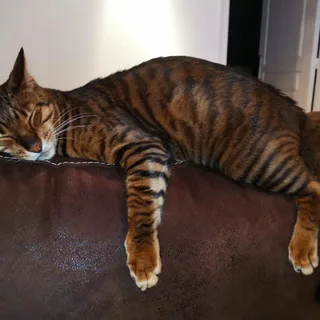
The Bengal is a medium to large-sized cat, with a long, muscular and elegant silhouette. Its bone structure is solid, its neck well developed and its medium-length legs reinforce its powerful and agile appearance. The head, rather triangular, has rounded ears and large, expressive eyes. Its short, dense and silky coat highlights very contrasted spotted, rosetted or marbled coats.
Temperament
Temperament and personality
The Bengal is a lively, curious and demonstrative cat, very attached to its family. It combines great intelligence with a playful temperament and a strong desire to interact. Affectionate without being passive, it likes to take part in household life and copes poorly with boredom when it lacks stimulation.
Living together
Living with children and animals
Very active, the Bengal likes to climb, run, watch and explore its environment. It retains a strong hunting instinct and particularly enjoys interactive games, elevated courses and activities that engage its thinking. It can live in an apartment if the space is well enriched, but it thrives more in a setting that allows it to expend energy daily.
Training
Training and socialization
The Bengal learns quickly when consistent routines, encouragement and motivating activities are used. It responds well to frequent interactions, educational games and the gradual learning of household rules. Early socialization and an enriching environment are important to channel its energy and avoid behaviors linked to frustration.
Budget
Bengal price & budget
The price of a Bengal varies greatly depending on the quality of the lineage, compliance with the standard, the tests carried out on the breeding cats, and the reputation of the cattery. An abnormally low offer should always prompt caution.
View cost breakdownHealth
Health at a glance
The Bengal is generally considered a rather robust cat, but like any selected breed, it may present certain predispositions that justify regular veterinary monitoring. A quality diet, a good level of activity and serious selection of breeding cats contribute greatly to its overall good health.
Prevention & watch pointsDiet
Feed it well
The Bengal needs a diet rich in good-quality animal proteins to support its muscle mass and activity level. The ration must be adapted to its age, weight, lifestyle and daily energy expenditure level.
Our feeding adviceDid you know?
Anecdotes and popularity
The Bengal owes its name to the Asian leopard cat Prionailurus bengalensis, from which it partially descends. Its appearance evokes a small wild feline, but the lines recognized in breeding are selected for their balance and sociability. This breed is also known for its unusual interest in water in many individuals.