Origins
Where does it come from?
The Basset Hound has deep French roots, but the breed was developed and perfected in Great Britain, then in the United States. It descends notably from the old Basset Artois, other old basset breeds and the Saint Hubert Hound. Highly appreciated as a scenthound for its nose, its tenacity and its ability to follow a trail, it became widely spread in Great Britain from the end of the 19th century, then across the Atlantic in the middle of the 20th century. Its friendly and sociable temperament then allowed it to become an appreciated companion dog. The Fédération Cynologique Internationale recognizes the breed under number 163, in group 6.
Appearance
What does it look like?
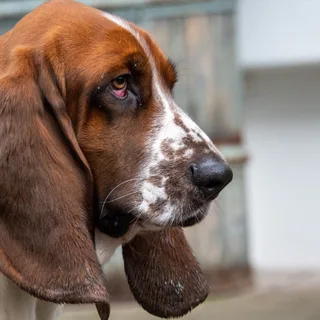
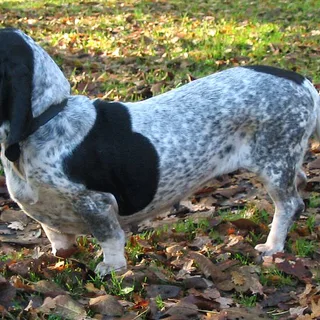
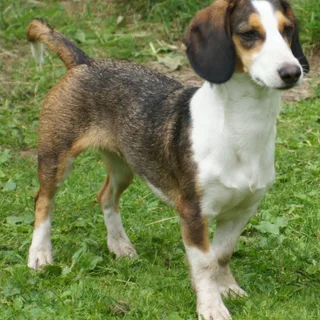
The Basset Hound is a powerful, harmonious, elongated dog and very low on legs. Its back is broad, its sternum prominent and its ribs well rounded. Its head with a domed skull has a marked occipital protuberance, a moderate stop, supple skin and a few light folds. Its long ears, set low, extend slightly beyond the tip of the muzzle. Its diamond-shaped eyes are dark to medium brown and give it a characteristic melancholy expression. Its coat is short, smooth and close. The coat can be tricolour black, tan and white, bicolour lemon and white, or show any other colour accepted in scenthounds. Its tail, fairly long and thick at the base, is carried high in a gentle curve when it is alert.
Temperament
Temperament and personality
Placid, gentle and friendly, the Basset Hound is generally very sociable with children, its fellow dogs and other animals. It is not very aggressive, readily playful and very attached to its home. Its indolent appearance hides a stubborn scenthound, endowed with a remarkable sense of smell, real strength and surprising endurance. Its hunting instinct is pronounced and an interesting scent can easily capture all its attention. It can also be vocal and make its deep voice heard.
Living together
Living with children and other pets
The Basset Hound seeks the company of its family and copes poorly with long and repeated solitude. It adapts to urban life and to apartment living if stairs are avoided and if it benefits each day from sufficient walks. It particularly enjoys outings in nature, where it can explore with its nose. Calm at home, it remains capable of following a trail for a long time outdoors. Its greediness and its unhurried pace require monitoring its weight without neglecting its need for activity.
Training
Training and socialization
His training must start early and remain firm, consistent, fair and kind. The Basset Hound understands what is expected of him, but his stubborn temperament and his interest in scents can slow down learning. Short, motivating and rewarded sessions give better results than power struggles. Recall and leash walking deserve special attention because of his chasing instinct. Early socialization complements his naturally sociable nature.
Budget
Price and budget for the Basset Hound
The purchase price depends on the quality of the breeding, the pedigree, the health guarantees, the bloodline, the age and the intended purpose of the dog. You must also anticipate the health, food, insurance and equipment expenses related to a heavy, low-slung dog.
See cost breakdownHealth
Health at a glance
The Basset Hound enjoys generally good health, but its long, low morphology requires particular vigilance. Weight control, back protection, long ear hygiene, eye cleaning and skin monitoring are essential throughout its life.
Prevention and things to watch forNutrition
Feeding your pet well
The diet of the Basset Hound must maintain correct muscle mass without promoting excess weight. A complete, digestible formula adapted to its age, its activity level and its body condition is recommended, with a precisely measured ration.
Our feeding adviceDid you know?
Fun facts and popularity
Despite its very short legs and its falsely sad expression, the Basset Hound is an active and enduring hunting dog. Its long ears and supple skin help to retain and direct scent particles toward its nose when it follows a trail. Its now iconic silhouette has largely contributed to its popularity as a family dog, without erasing its abilities as a scenthound.