Origins
Where does it come from?
The Turkish Angora is an ancient breed originating from Ankara, formerly called Angora, in Turkey. Highly appreciated for its slender silhouette and silky coat, it was introduced to Europe in the 17th century and quickly aroused the interest of courts and artists. The breed then experienced a decline in the face of the success of the Persian, before being revived by European and American breeders after the Second World War. It is now recognized by the main feline organizations.
Appearance
What does it look like?
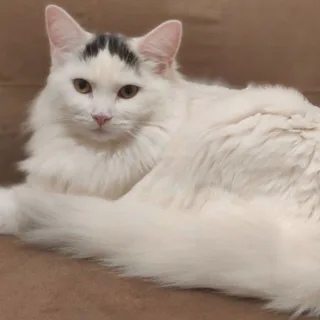
The Turkish Angora is a slender, fine and elegant cat, but well muscled under its coat. Its head forms a triangle with softened lines, with large upright ears and slightly slanted almond-shaped eyes. Its coat is semi-long to long, light, silky and low in undercoat, with more abundant fur on the belly, chest and tail. All colors are accepted except chocolate, cinnamon, lilac and fawn, even if the white coat remains the most emblematic.
Temperament
Temperament and personality
The Turkish Angora is a sociable, demonstrative and intelligent cat. It enjoys the company of its family, readily seeks petting and may like being the center of attention. It nevertheless retains a degree of independence and a strong-willed temperament. Playful, agile and lively, it generally gets along well with children, its fellow cats and other pets when it is well socialized.
Living together
Living with children and animals
On a daily basis, the Turkish Angora is active, curious and agile in its movements. It likes to explore, climb and play, and does not tolerate well a life that is too confined or monotonous. It can alternate moments of calm with phases of marked activity, especially if it has space and stimulation. It is also known for its unusual attraction to water for a cat.
Training
Training and socialization
The Turkish Angora can be trained fairly easily thanks to its quick wit and its closeness to humans. Early socialization, stable routines and positive reinforcement help to guide its assertive temperament without making it shut down. It enjoys interactive games, high perches and activities that stimulate its intelligence. An enriched environment helps it stay balanced.
Budget
Turkish Angora price & budget
The price of a Turkish Angora varies depending on rarity, type, health tests and socialization. Maintenance (food, litter, veterinarian) represents a regular budget.
View cost breakdownHealth
Health at a glance
The Turkish Angora is overall a solid and robust cat. It does not show any major widely recognized predisposition to a large number of specific diseases, but regular veterinary follow-up remains essential as for any purebred cat. Vaccination, parasite prevention and monitoring of development in the kitten remain essential.
Prevention & watch pointsDiet
Feed it well
The Turkish Angora needs a high-quality diet, rich in animal proteins, vitamins and trace elements to support its muscle mass, activity level and the beauty of its coat. A well-digested ration adapted to its age, lifestyle and physiological status should be preferred.
Our feeding adviceDid you know?
Anecdotes and popularity
The Turkish Angora owes its name to the city of Ankara, formerly Angora. Long admired in European courts for its refined appearance, it nearly disappeared before being preserved by dedicated breeding programs. It is also known for liking water more readily than many other cats, a trait often cited by its enthusiasts.