Origins
Where does it come from?
The Balinese comes from the United States and descends directly from the Siamese. Long-haired or semi-long-haired kittens appeared in Siamese litters among American breeders as early as the 1920s. First excluded from breeding, they aroused the interest of Marion Dorsey from 1950, with the help of Helen Smith, to develop a new breed. Its name refers to the dancers of Bali and not to an Indonesian origin. The breed was recognized in 1961 by the Cat Fanciers' Federation.
Appearance
What does it look like?
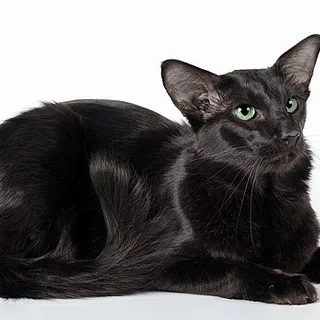
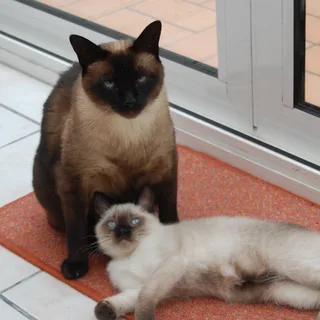
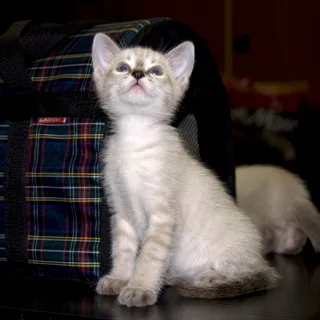
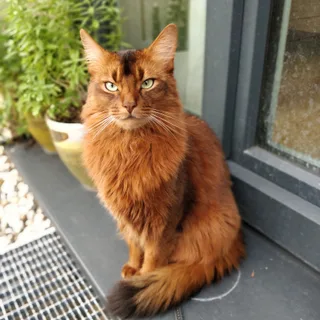
Of medium size, the Balinese has a long, elegant and well-proportioned body, carried by a fine bone structure. Its triangular head gives it a characteristic expression. Its large ears are fine, pointed and extend the lines of the head. Its almond-shaped eyes are blue. Its silky coat, lying close to the body and lacking an undercoat, varies from semi-long to long. Its well-furnished tail, carried lightly, evokes a feather. The main pattern is colourpoint, with extremities darker than the body; the accepted colours include in particular frost, blue, chocolate, cream, red and lilac.
Temperament
Temperament and personality
Demonstrative, sensitive and very affectionate, the Balinese forms a close bond with its owner and readily seeks their attention. Intelligent, active and playful, it retains an athletic temperament and a hunter’s instinct. Like the Siamese, it frequently communicates by voice, but its meow is said to be less shrill. It also knows how to withdraw to a quiet place and is attentive to the emotions of those around it.
Living together
Living with children and animals
Very attached to its human, the Balinese likes to follow them in their activities and copes poorly with a life lacking in interactions. It enjoys games, elevated routes and opportunities to climb. Sociable, it generally lives well with other animals and can become a good play companion for respectful children; its sociability with strangers is more moderate. It accepts apartment living if its environment includes a cat tree, toys and daily stimulation; a house with a garden can also satisfy its need for exploration, provided that outings are secured.
Training
Training and socialization
The Balinese learns easily thanks to its intelligence, curiosity and love of play. A gentle, consistent education based on positive reinforcement makes it possible to teach it the rules of the home, the use of the scratching post and interactive games. Short, varied sessions suit its active and sensitive temperament better than constraints or reprimands.
Budget
Balinese price & budget
The price of a Balinese varies depending on the lineage, the pedigree, the reputation of the cattery, the quality of health monitoring, and the cat’s intended purpose, companionship or breeding.
View cost breakdownHealth
Health at a glance
The Balinese is described as robust, but certain hereditary conditions may affect it. Regular veterinary monitoring, particularly of the eyes, the heart and kidney function, remains recommended. Vaccination against panleukopenia, cat flu and leukemia depending on lifestyle, as well as rabies vaccination when it is required, complete routine prevention.
Prevention & watch pointsDiet
Feed it well
The Balinese must receive a complete and balanced diet, adapted to its age, its morphology, its activity level and its state of health. Maintaining a slender silhouette is a priority.
Our feeding adviceDid you know?
Anecdotes and popularity
The Balinese is also called Balinese or Longhair Siamese. Despite its name, it was born in the United States; the name evokes the grace of Balinese dancers. Its medium-long to long coat distinguishes it from the Siamese, with which it shares many physical and behavioral traits.