Origins
Where does it come from?
The Irish Wolfhound descends from ancient large-sized sighthounds bred in Ireland by the Celts. It was long used for hunting wolves and deer, before declining with the gradual disappearance of this game in Europe. The breed was revived in the 19th century, then structured by the creation of its club in 1885 before its definitive recognition by the FCI in 1955.
Appearance
What does it look like?
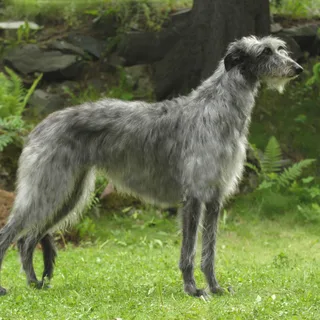
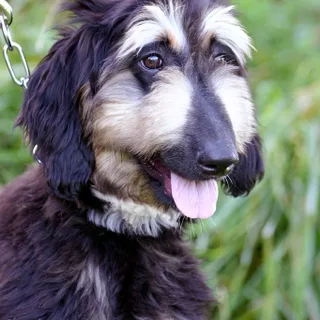
The Irish Wolfhound is a giant, powerful and elegant dog, more massive than the Scottish Deerhound. Its body is long and sturdy, with a deep chest, a strong and muscular neck, an elongated head carried high and a long slightly curved tail. Its coat is harsh and rough, with a more pronounced wire-haired appearance above the eyes and under the jaw.
Temperament
Temperament and personality
Peaceful and affectionate at home, the Irish Wolfhound remains energetic, determined and very much a hunter outdoors. It is generally gentle with its family, rather sociable with humans, but its chasing instinct can complicate living with certain small animals.
Living together
Living with children and animals
This large sighthound needs space, long and regular outings and a calm environment to remain balanced. He appreciates the company of his family, does not tolerate a life that is too confined and thrives more in a house with a well-fenced garden than in an apartment.
Training
Training and socialization
The education of the Irish Wolfhound must begin early, with firmness, patience and consistency. It is a sensitive dog that responds better to positive reinforcement than to constraint. Recall and the management of its hunting instinct must be worked on from the youngest age to obtain a reliable companion that is pleasant to live with.
Budget
Irish Wolfhound price & budget
The Irish Wolfhound remains an uncommon breed whose purchase price mainly reflects the quality of the breeding, the seriousness of the selection and the health monitoring of the breeding dogs. Its large size also implies significant maintenance expenses over time.
View cost breakdownHealth
Health at a glance
The Irish Wolfhound is generally hardy and robust, but its large size requires particular vigilance regarding the musculoskeletal system, the heart and the digestive system. Like many giant breeds, it requires serious veterinary monitoring and careful management of exercise, growth and meals.
Prevention & watch pointsDiet
Feed it well
The Irish Wolfhound needs a high-quality diet, adapted to its age, its activity and its very large size. Dietary management is particularly important during growth, in order to support development without promoting excessive weight gain or growth that is too rapid.
Our feeding adviceDid you know?
Anecdotes and popularity
The Irish Wolfhound is often cited among the largest dogs in the world. Despite its impressive size, it is known for its gentleness at home, which gives it an image of a calm and noble giant among sighthound enthusiasts.