Origins
Where does it come from?
Despite its name, the Japanese Spaniel is said to have ancient origins linked to Korea before being introduced to the Japanese imperial court during the 8th century. The breed then became firmly established in Japan, where it was particularly appreciated in aristocratic circles, then reached England in the 17th century. Its type was fixed over time as that of a refined small companion dog, and the FCI recognized it definitively in 1957.
Appearance
What does it look like?
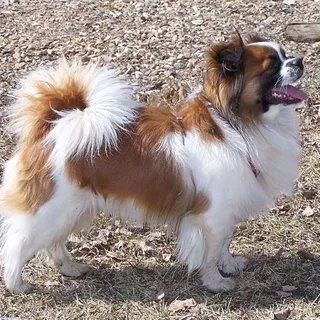
The Japanese Spaniel is a small compact dog, graceful and elegant, with a harmonious silhouette and a short, straight back. Its head is broad and rounded, the forehead domed, the muzzle very short and the face expressive. Its large round eyes, its drooping well-fringed ears and its tail carried over the back reinforce its distinguished appearance. Its coat is long, straight and silky, abundant on the body, most often white with black or red markings.
Temperament
Temperament and personality
The Japanese Spaniel is an alert, loyal, very affectionate dog and of great gentleness with those close to it. It seeks human company, is receptive to its owner and enjoys a calm home life. It often remains reserved with strangers without being aggressive, which makes it above all an excellent companion dog.
Living together
Living with children and animals
This small dog readily lives indoors and adapts very well to apartment living, provided it receives attention and affection on a daily basis. It likes to play, observe its surroundings and take part in household life, but its physical needs remain moderate. It does not tolerate prolonged solitude well and thrives more in a present and attentive environment.
Training
Training and socialization
His intelligence and his attentiveness to humans make learning easier, but his training requires gentleness, patience and consistency. Harsh methods should be avoided, while play, encouragement and short routines give good results. As a first dog, he can surprise with his sensitivity and his slightly reserved side, which requires a calm and persevering owner.
Budget
Japanese Chin price & budget
The purchase price of the Japanese Spaniel varies depending on the lineage, the reputation of the breeding kennel, compliance with the standard and the follow-up offered. For an uncommon breed, availability can also influence the budget and the waiting time.
View cost breakdownHealth
Health at a glance
The Japanese Spaniel is a breed with generally good longevity but rather delicate, which requires careful monitoring of certain health points. Its morphology as a small short-faced dog and its large eyes notably expose it to ocular and respiratory fragilities. Regular care, a calm lifestyle and regular veterinary check-ups help to keep it in good shape.
Prevention & watch pointsDiet
Feed it well
The Japanese Spaniel needs a complete and highly digestible diet, adapted to its small size, its age and its moderate activity level. The quality of the ingredients, the regularity of meals and control of treats matter more than the volume.
Our feeding adviceDid you know?
Anecdotes and popularity
Often called Chin, the Japanese Spaniel has long been associated with the noble courts of Asia and imperial Japan. Its refined appearance and its very distinctive expression have made it popular as a companion dog in aristocratic circles, then among British high society. Although it sometimes recalls the Pekingese by its face and its coat, it retains a lighter and more lively style in its attitudes.