Origins
Where does it come from?
The first references to the Continental Toy Spaniel date back to the Middle Ages. The breed is said to have been obtained by reducing the size of larger hunting spaniels. The phalene variety is considered the oldest, while the papillon variety mainly developed at the end of the 19th century. Highly appreciated in aristocratic circles and royal courts, this small companion dog was definitively recognized by the FCI in 1954.
Appearance
What does it look like?
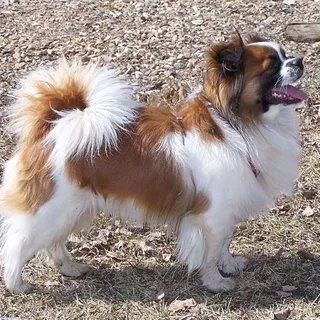
The Continental Toy Spaniel is a small dog harmoniously built, slightly longer than tall, with a lively and graceful gait. Its coat is long, abundant, shiny and finely wavy without being curly. Its expressive head carries large fringed ears, erect in the Papillon variety and drooping in the Phalène variety. The base coat remains white with varied colored markings, the white having to remain dominant on the body.
Temperament
Temperament and personality
Affectionate, cheerful and very attached to its owner, the Continental Toy Spaniel is a charming and demonstrative family companion. It combines liveliness, gentleness and good humor, while remaining fairly discreet at home. Not very inclined toward guarding, it seeks above all human closeness and positive interactions.
Living together
Living with children and animals
This small dog adapts easily to very different lifestyles, provided it enjoys daily walks and playtime. It likes to take part in household life, observe its surroundings and share activities with its human. In an apartment, its small size and relatively calm temperament make it a pleasant companion if it is not left alone for too long.
Training
Training and socialization
His training benefits from being gentle, consistent and early. As he is sensitive and very attached to those around him, positive methods generally give good results. However, you must avoid overprotecting him too much and set clear limits in order to maintain a balanced, well-mannered and easy-going dog.
Budget
Continental Toy Spaniel price & budget
The purchase price varies mainly depending on the seriousness of the breeding, the origin of the breeding stock and the quality of the follow-up offered. For this breed, it is preferable to favor a well-socialized puppy, identified and health-monitored rather than an abnormally low-priced listing.
View cost breakdownHealth
Health at a glance
Despite its small size, the Continental Toy Spaniel is rather sturdy and often enjoys good longevity. Its health monitoring must nevertheless remain regular, notably for the joints, dentition and ear care depending on the variety. Like many small dogs, it benefits from rigorous hygiene and constant veterinary follow-up.
Prevention & watch pointsDiet
Feed it well
The Continental Toy Spaniel needs a complete, highly digestible diet adapted to small dogs. The quality of the ingredients, a sensible energy density and the right kibble size matter as much as the quantity served.
Our feeding adviceDid you know?
Anecdotes and popularity
The breed includes two official varieties: the papillon, with erect ears, and the phalene, with drooping ears. The refined appearance of this small dog earned it great popularity in European courts and in many old portraits. Even today, it stands out for its elegance and liveliness.