Origins
Where does it come from?
Ancient breed that appeared around the 14th century, the Bichon Frise is said to have resulted from crosses between the Barbet and small bichons, notably the Maltese Bichon. Long called the Bichon of Tenerife, it arrived in France in the 16th century and charmed the courts of François I and then of Henry III. Its popularity then declined, but a Belgian breeder helped to preserve the breed after the Second World War. The Fédération Cynologique Internationale definitively recognized it on 28 October 1959 under standard number 215.
Appearance
What does it look like?
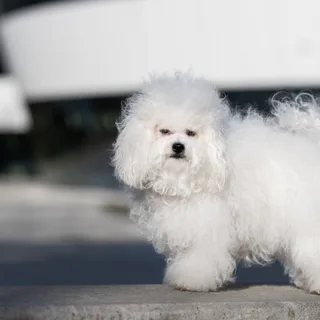
The Bichon Frise is a small, harmonious dog with a proud head carriage and a lively expression. Its skull is rather flat, its stop not very marked and its nose round and very black. Its dark, rounded eyes contrast with its pure white coat. The fine, drooping ears are covered with long, curly hair. The body has a broad, muscular loin, a developed chest and a tucked-up belly. The tail, set slightly below the topline, is carried raised and curved without curling over. Its coat, 7 to 10 cm long, is fine, silky, supple and corkscrew-curled, never flat nor corded.
Temperament
Temperament and personality
Lively, cheerful, playful and very attached to its family, the Bichon Frise readily seeks human closeness. It also knows how to be calm at home and generally gets along very well with children as well as with other animals when it is properly socialized. Not very independent and lacking a true guarding instinct, it primarily fulfills the role of a companion dog.
Living together
Living with children and animals
This small dog adapts very well to life in an apartment as well as to a house with a fenced garden, provided it lives close to its owners. It copes poorly with long periods of solitude and can become anxious if absences are not prepared gradually. A daily walk, games and indoor activities are generally enough for its balance, despite its lively and playful temperament.
Training
Training and socialization
The Bichon Frise is gentle, docile and intelligent. Its training remains accessible to a beginner owner if it starts early and combines consistency, gentleness and clear rules. Positive methods, short sessions and rewards maintain its motivation. It is advisable to work as a priority on house-training, recall, leash walking and the gradual learning of being alone, without giving in to all its demands.
Budget
Bichon Frise price & budget
The purchase price varies depending on the reputation of the kennel, the quality of the lineage, the health tests carried out on the breeding dogs, the pedigree and the puppy’s intended purpose. A consistent price must be accompanied by transparent information about the parents, socialization and veterinary follow-up.
View cost breakdownHealth
Health at a glance
The Bichon Frise benefits from an overall solid constitution and good longevity. It nevertheless has known predispositions affecting in particular the joints and the eyes. Regular veterinary follow-up, good oral hygiene and maintaining a stable weight help to preserve its health.
Prevention & watch pointsDiet
Feed it well
A complete diet intended for small-sized dogs is suitable for the Bichon Frise. It must provide quality animal proteins, an appropriate energy density, and nutrients that promote the skin, coat, and oral health.
Our feeding adviceDid you know?
Anecdotes and popularity
Formerly called the Bichon of Tenerife, it was particularly appreciated in the French royal courts of the Renaissance. Its coat exclusively pure white and its corkscrew curls give it an immediately recognizable silhouette. The breed narrowly avoided decline before being saved notably thanks to the work of a Belgian breeder after the Second World War.