Origins
Where does it come from?
The origins of the Bichon Bolognese are partly intertwined with those of the Maltese Bichon. Their ancestors are said to be the small dogs called "canes melitenses" by Aristotle in the 4th century BC. Already appreciated under the Roman Empire, this companion dog long frequented wealthy families and European courts. It appears in works by Titian, Pieter Brueghel the Elder and Francisco de Goya. The Fédération Cynologique Internationale definitively recognized the breed on 5 March 1956, under standard number 196.
Appearance
What does it look like?
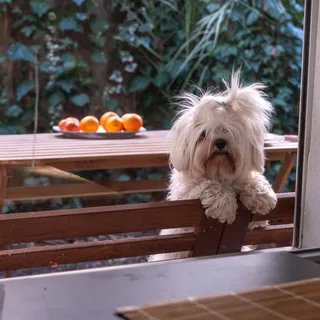
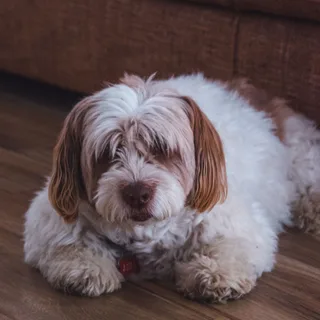
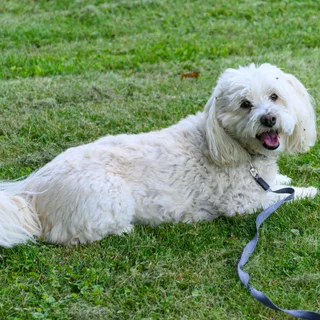
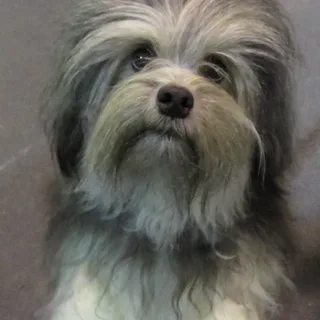
The Bichon Bolognese is a small compact dog, cobby and square in outline. Its head of medium length has a slightly ovoid skull and a not very marked stop. Its fairly large, dark and not prominent eyes give it an attentive expression. Its long ears are set high and hanging. The back is straight, the loin short and solid, the chest ample and the tail, well furnished, curves over the back. Its coat is long over the whole body, dense, silky and shorter on the muzzle. The coat is pure white, with slight ivory shades permitted.
Temperament
Temperament and personality
Naturally gentle, calm and very affectionate, the Bichon Bolognese shows itself to be deeply attached to its family. It is a little more reserved than some other bichons, but remains sociable, intelligent and able to adapt to people as well as to situations. It appreciates children, generally cohabits well with other dogs and cats, and willingly welcomes strangers when it has been properly socialized. Its guarding instinct is weak and its vocation is above all that of a companion dog.
Living together
Living with children and animals
The Bichon Bolognese seeks closeness to its owners and does not cope well with prolonged absences. Indoors, it is calm and adapts very well to an apartment as well as to a house. It nevertheless needs a daily walk, games and regular interactions to maintain its balance and limit weight gain. Its tendency to vocalize may appear when it is bored, left alone or perceives unusual agitation.
Training
Training and socialization
Calm, obedient and intelligent, the Bolognese Bichon generally learns easily. Early, consistent and kind training, combining gentleness, measured firmness and rewards, gives very good results. Socialization must gradually get it used to people, animals, noises and being alone. It is also advisable to work on recall, walking on a leash and calmness in order to prevent vocalizations and excessive attachment.
Budget
Bolognese price & budget
The price of a Bichon Bolonais varies depending on the quality of the breeding kennel, the pedigree, the screenings carried out on the breeding dogs, compliance with the standard and the puppy’s intended purpose. The breed’s relative rarity can also influence availability and waiting times.
View cost breakdownHealth
Health at a glance
The Bolognese Bichon generally enjoys robust health when it receives regular care and remains protected from harsh weather conditions. Particular monitoring should focus on its kneecaps, its eyes, its weight and its oral hygiene. Choosing a breeder that carries out the useful screenings and an annual veterinary check-up helps to limit the risks.
Prevention & watch pointsDiet
Feed it well
A complete diet intended for small-sized dogs is suitable for the Bichon Bolonais. It must be sufficiently digestible, adapted to its age and precisely measured in order to cover its needs without promoting overweight. Body condition, stool quality, coat and activity level serve as benchmarks to adjust the ration with the veterinarian.
Our feeding adviceDid you know?
Anecdotes and popularity
The Bichon Bolonais was depicted by several great European painters, including Titian, Pieter Brueghel the Elder and Francisco de Goya, a sign of the place it held among privileged families. Its calm and sociable temperament also allows it to be appreciated as a mediation dog with vulnerable or hospitalized people.