Origins
Where does it come from?
The Cavalier King Charles Spaniel has been known since the 16th century in England and remains closely linked to King Charles II, who particularly appreciated these small companion spaniels. At the beginning of the 19th century, contributions from the King Charles Spaniel, the Pekingese and the Pug helped to establish the current characteristics of the breed. A first standard was established in 1928 in Great Britain, where the breed club was founded around the same time. The breed was recognized by the Kennel Club in 1945, then definitively by the FCI on 20 January 1955. The official FCI standard currently in force was published on 4 November 2008, and the first representatives of the breed arrived in France in 1975.
Appearance
What does it look like?
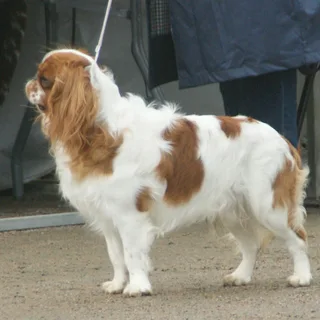
The Cavalier King Charles is a small, well-proportioned dog, elegant and graceful, with a free-moving gait and an overall impression of great gentleness. Its body is harmonious, with a moderately long and slightly arched neck, a straight back, a short loin and well-sprung ribs. The ears are set high, long and abundantly feathered. The eyes are large, round, dark and well spaced. The skull is almost flat, the stop slightly marked, the nostrils black and well developed, and the jaws have a scissor bite. The tail is proportionate, well set on and carried gaily without exceeding the line of the back. The coat is long, silky, with abundant feathering, and may be slightly wavy. The accepted coat colors are black and tan, ruby, blenheim and tricolor.
Temperament
Temperament and personality
The Cavalier King Charles is a cheerful, lively but calm dog, free of aggressiveness, playful, friendly, sociable and courageous. Its pleasant and well-balanced personality makes it an excellent family companion, able to get along equally well with children as with elderly people and other animals.
Living together
Living with children and animals
The Cavalier King Charles enjoys family life and prefers to stay close to its owners. It likes to have access to an enclosed outdoor space, but adapts well to indoor life if several daily walks are offered. It often suffers from loneliness without always showing it. Usually discreet, it can however become more prone to barking in the presence of other dogs, while remaining not very quarrelsome with its fellow dogs.
Training
Training and socialization
The Cavalier King Charles is relatively easy to train. Obedient but often distracted, he is very attached to his owner and seeks to please him. His training must remain both gentle and firm, without excessive permissiveness despite his natural charm.
Budget
Cavalier King Charles price & budget
The purchase price varies mainly depending on the quality of the selection, the reputation of the breeding kennel, the health tests carried out on the breeding dogs, and compliance with the standard. A higher price can be justified by serious work on socialization and health monitoring.
View cost breakdownHealth
Health at a glance
The robustness of the Cavalier King Charles is average, with a rating of 3 out of 5 on the reference page. The breed has cardiac predispositions and several ophthalmic, neurological, dermatological and orthopedic sensitivities that justify careful veterinary monitoring.
Prevention & watch pointsDiet
Feed it well
The Cavalier King Charles generally receives an industrial diet based on high-quality kibble. The ration must then be adapted to its daily activity and to its possible tendency to gain weight.
Our feeding adviceDid you know?
Anecdotes and popularity
The breed’s name refers to King Charles II of England, who was particularly fond of these small spaniels. Among the famous representatives is Rex, companion of Ronald and Nancy Reagan at the White House before following the couple to California.