Origins
Where does it come from?
The Mexican Hairless Dog is a very ancient and primitive breed, whose evolution has been little influenced by human beings. In pre-Hispanic times, the indigenous populations of Mexico consumed its flesh, notably during ritual ceremonies, because they associated this dog with Xolotl, a divinity at the origin of its name. The numbers thus decreased sharply to the point of placing the breed on the brink of extinction. Since 1940, the Federación Canófila Mexicana has worked for its perpetuation. The Fédération Cynologique Internationale definitively recognized the breed on 6 November 1961 under number 234, in group 5. The official FCI standard currently in force was published on 8 October 2012.
Appearance
What does it look like?
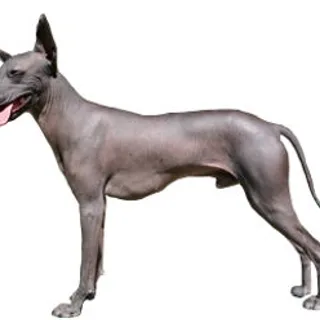
Slim, elegant and moderate in all its proportions, the Mexican Hairless Dog gives an impression of speed and strength without coarseness. Its body is built strongly and harmoniously, with a straight topline, a short and firm back, a muscular loin, a long and deep chest and a slightly tucked-up abdomen. Its lupoid head has a broad and wedge-shaped skull, a slight but defined stop, tight lips and strong jaws. Its medium almond-shaped eyes express attentiveness and intelligence. Its ears are long, broad, not very thick and mobile. Its long, fine tail ends in a point. The hairless variety has soft and elastic skin, totally or almost devoid of hair, while the coated variety has a short, flat coat without undercoat. The color is uniform and dark, from gray to black, to red, to liver or to bronze, with possible white markings in the hairless variety.
Temperament
Temperament and personality
The Mexican Hairless Dog is calm, cheerful, intelligent and never aggressive, which makes it an excellent companion. Naturally attentive and wary of strangers, it also proves to be a good watchdog. It is affectionate with its own, moderately independent and its hunting instinct remains restrained.
Living together
Living with children and animals
Discreet and not very demanding in terms of space, the Mexican Hairless Dog adapts very well to life in the city and in an apartment, even if access to a large fenced garden remains preferable. It needs moderate activity, but its daily outings remain essential to its physical, psychological and emotional balance. Its sociability with children is average and cohabitation with other animals requires careful socialization.
Training
Training and socialization
His training must be gentle, patient and free of any brutality. Early handling and quality socialization are necessary. Methods based on positive reinforcement are particularly suited to this intelligent dog, whose obedience is not spontaneous.
Budget
Xoloitzcuintli price & budget
The purchase price varies depending on the breeder, the lineage and the characteristics of the dog. The annual maintenance budget indicated by the source is between 250 and 500 euros.
View cost breakdownHealth
Health at a glance
The Mexican Hairless Dog is vigorous and has overall robust health. However, its lack of coat makes it more sensitive to harsh climatic conditions. The breed is considered hypoallergenic.
Prevention & watch pointsDiet
Feed it well
A classic quality industrial diet is suitable for the Mexican Hairless Dog when it is adapted to its age, its size and its level of physical activity.
Our feeding adviceDid you know?
Anecdotes and popularity
The Mexican Hairless Dog is also known under the names Xoloitzcuintle, Xolo, Perro sin Pelo Mexicano and Mexican Hairless Dog. It exists in three sizes, standard, intermediate and miniature, as well as in two varieties, hairless or coated. The hairless variety is distinguished notably by dentition that is often incomplete.