Origins
Where does it come from?
The Peruvian Hairless Dog is a very ancient breed. Archaeological excavations have uncovered ceramic objects depicting dogs that resemble it, originating from several cultures predating the Incas, notably from the Chancay civilization between 1200 and 1470. The Fédération Cynologique Internationale definitively recognized the breed on 30 June 1981. Its official FCI standard currently cited by the source was published on 8 October 2012.
Appearance
What does it look like?
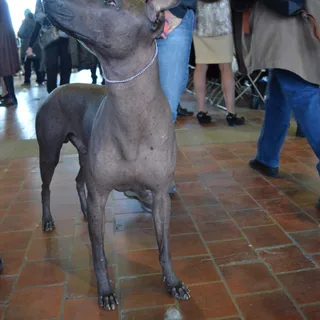
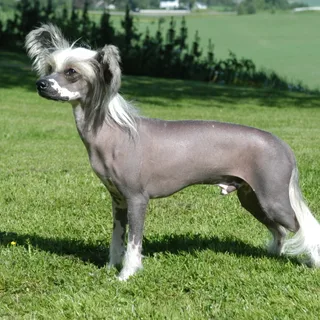
The Peruvian Hairless Dog has a slim, elegant and harmonious silhouette that evokes both speed and strength. Its body, which can be inscribed in a square, has a straight and muscular back, a strong loin, a solid croup and a fairly ample chest. Its wolf-like head tapers towards the nose, with medium eyes slightly almond-shaped and ears carried erect when it is attentive. The tail, set low, tapers towards its tip and rises in a curve without curling when the dog is excited. The hairless variety sometimes has a few hairs on the head, the ends of the limbs, the tail or the back, while the coated variety has a soft, short and straight coat. All colours and combinations of colours are accepted.
Temperament
Temperament and personality
Noble and affectionate, the Peruvian Hairless Dog is particularly attached to the members of its household. It is alert and rather wary of strangers. This vigilance makes it a dog capable of warning its family when an unusual presence appears.
Living together
Living with children and animals
Discreet at home and close to his family, he can live in different types of households, including in an apartment. However, he needs long daily walks, games and exercise to preserve his physical and emotional balance. A life mainly indoors suits him better in order to protect him from climatic rigors.
Training
Training and socialization
Its training does not present any particular constraints, but it must favor gentleness, consistency and measured firmness, without brutality. A calm and coherent approach facilitates its learning.
Budget
Peruvian Inca Orchid price & budget
The purchase price varies notably depending on the breeder, the lineage and the dog's characteristics. It is advisable to favor a reputable breeder who ensures health monitoring and the socialization of the puppies.
View cost breakdownHealth
Health at a glance
Despite the apparent fragility linked to its hairless skin, the Peruvian Hairless Dog generally enjoys robust health. Its skin nevertheless requires regular monitoring and it must be protected from the cold as well as from bad weather.
Prevention & watch pointsDiet
Feed it well
The Peruvian Hairless Dog can receive quality industrial food, given in two meals per day. The chosen formula must correspond to its age, its size and its level of physical activity.
Our feeding adviceDid you know?
Anecdotes and popularity
The breed exists in two varieties, one hairless and the other provided with a short coat. In the hairless variety, dentition may be incomplete. It is also known under the names Peruvian Hairless Dog, Inca Hairless Dog, Perro sin pelo del Perú and Peruvian Hairless Dog.