Origins
Where does it come from?
The Norwegian Black Elkhound is a very ancient breed developed in Norwegian forests for hunting big game, mainly the moose. The first Norwegian Elkhounds were presented at a show in 1877 by the Norwegian Hunters Association. The British Elkhound Society was founded in 1923, then the Norwegian Elkhound Association of America seven years later. The Fédération Cynologique Internationale definitively recognized the breed on 7 October 1965, under number 268 of group 5.
Appearance
What does it look like?
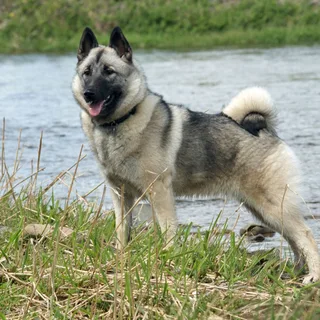
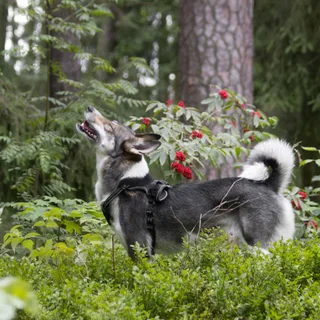
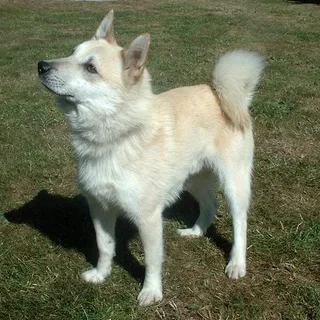
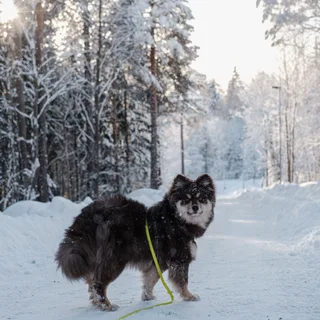
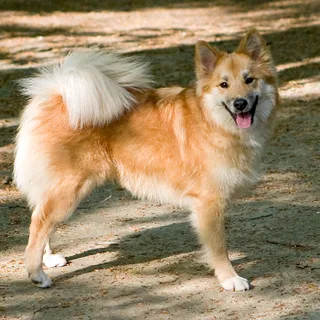
Solidly built, the Norwegian Black Elkhound has a compact body that can be inscribed in a square. Its wedge-shaped head, lean and light, tapers toward a black nose; its dark brown eyes are not prominent and its pointed ears are erect and set high. The back is straight and powerful, the chest well let down and the croup broad and muscular. The short, thick tail, set high, curls over the back. Its medium-length, dense, close, harsh and well-lying topcoat is combined with a soft, woolly undercoat. The coat is entirely black and shiny. Its gaits are light, supple and parallel. The male measures from 46 to 49 cm for 23 to 27 kg; the female measures from 43 to 46 cm for 18 to 25 kg.
Temperament
Temperament and personality
Determined, courageous and very energetic, the Norwegian Black Elkhound is also sociable and affectionate. Its hunting instinct is pronounced. A good watchdog, protective and attentive, it readily barks to warn its owners.
Living together
Living with children and animals
This dog needs space and activity. Two long daily outings are necessary to meet its high energy level. A house with a large fenced garden suits it better than an apartment. Playful and athletic, it is preferably intended for a person who knows the needs of Spitz-type dogs and has a minimum of experience in dog training.
Training
Training and socialization
Its rather primitive character typical of Spitz dogs requires a firm, consistent handling without a power struggle. Quality socialization must begin from the earliest age in order to encourage balanced behavior with people and other animals.
Budget
Norwegian Elkhound (Black) price & budget
The price of a Black Norwegian Elkhound varies depending on the lineage, the seriousness of the breeding, the screenings and the socialization. The maintenance budget (food, veterinarian, training) often exceeds the purchase price over time.
View cost breakdownHealth
Health at a glance
The Norwegian Black Elkhound is hardy and has overall robust health. Its double coat effectively protects it from low temperatures and humidity. The breed nevertheless has predispositions to pyoderma and generalized retinal atrophy.
Prevention & watch pointsDiet
Feed it well
The Norwegian Black Elkhound needs a complete, digestible diet adapted to its age, its activity and its body condition. An adult generally weighs from 18 to 27 kg. The quality of the ration and weight control protect digestion and joints.
Our feeding adviceDid you know?
Anecdotes and popularity
The breed is also known under the names Black Norwegian Elkhound and Norsk Elghund Sort. It is distinguished from its close cousin, the Norwegian Grey Elkhound, mainly by its uniformly black and shiny coat. The indicated litters number from 7 to 14 puppies.