Origins
Where does it come from?
The Norwegian Grey Elkhound is a very ancient Scandinavian breed, long used for hunting big game, notably the moose, but also the bear and the wolf. It is presented for the first time at a show in 1877 by the Norwegian hunters' association. The Elkhound association is founded in 1923, then the breed is officially recognized by the British Kennel Club. The Norwegian Elkhound Association of America is established in the United States during the following decade.
Appearance
What does it look like?
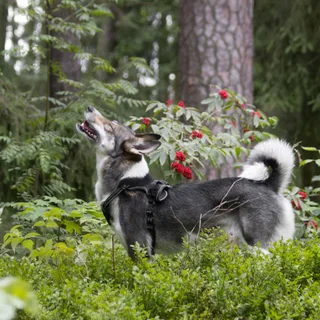
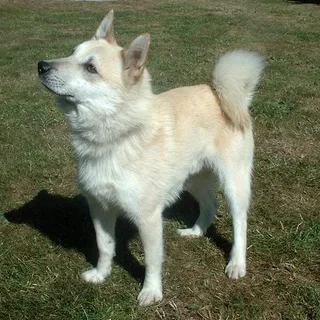
Of compact, strong build and fitting into a square, this spitz has a dry, wedge-shaped head, dark brown eyes, small triangular ears well erect and a thick tail carried curled over the back. Its medium-long, harsh, dense and never curly topcoat is associated with a soft undercoat. The coat is grey in different shades, black-tipped at the ends, lighter on the chest, belly, limbs and the underside of the tail, with a darker mask. The neck bears an abundant ruff, the back is straight and strong, the chest roomy and the ribs well sprung.
Temperament
Temperament and personality
Brave, determined and very energetic, the Norwegian Grey Elkhound retains a strong hunting instinct. He is affectionate with his family, vigilant and protective, while keeping a certain independence. His early socialization is important, especially with other animals, because his hunter temperament can complicate cohabitations that are insufficiently prepared.
Living together
Living with children and animals
This active dog needs to exercise every day and enjoys long walks, ideally one to two sustained outings. He can be vocal and readily alert. A house with a large, well-fenced garden suits his needs better than an apartment, without replacing outings and activities shared with his owner.
Training
Training and socialization
As docility is not its dominant trait, its training must start early and combine firmness, consistency, fairness and positive reinforcement. Any brutality must be avoided. Regular work on recall, leash walking, prey drive management and socialization is particularly useful to channel its energy and independence.
Budget
Norwegian Elkhound price & budget
The purchase price depends in particular on the breeder, the lineage, the pedigree, the health tests and the dog's intended purpose. The annual maintenance budget indicated by the source is between 600 and 800 euros, excluding unforeseen veterinary expenses.
View cost breakdownHealth
Health at a glance
With a solid build, the Norwegian Grey Elkhound has a double coat that effectively protects it from harsh weather conditions. Particular vigilance remains necessary for its eyes, its joints, its skin and the risk of gastric dilatation-volvulus.
Prevention & watch pointsDiet
Feed it well
The Norwegian Grey Elkhound needs a quality, balanced diet adapted to its size, age, body condition and high level of physical activity.
Our feeding adviceDid you know?
Anecdotes and popularity
The breed is also known under the names Grey Elkhound, Norwegian Elkhound and Norsk Elghund Gra. It bears the FCI number 242 and belongs to group 5 of Spitz-type and primitive-type dogs. The FCI has recognized it since 1963. A litter generally includes 5 to 10 puppies.