Origins
Where does it come from?
Despite its long history, the Swedish Elkhound breed was only recognized in the aftermath of the Second World War. Originating from northern Sweden, it had to be distinguished from the Norwegian Elkhound, some having once considered that it was one and the same breed. Besides the moose, this dog was traditionally used for hunting bear and lynx.
Appearance
What does it look like?
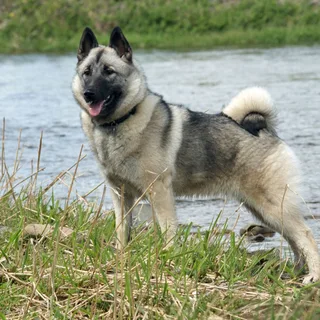
The Swedish Elkhound is a large Spitz-type hunting dog, strong, solid and agile, able to fit into a rectangle without an impression of heaviness. Its body, slightly longer than tall, shows a straight topline and slightly sloping between the withers and the croup, a broad loin, a broad and very slightly sloping croup, a well let-down chest, well-sprung ribs and a slightly tucked-up belly. Its rather long head is broad between the ears, with a slightly domed skull, a distinct but moderate stop, a broad nose, a straight and broad bridge of the nose, a muzzle that tapers gradually, close-fitting lips, scissor jaws and clean cheeks. The ears are erect, pointed and set high. The oval, brown eyes express both alertness and calm. The tail, of medium length and even thickness, is set high, bushy without fringes and curled over or against the back. The coat lies close without being flat, shorter on the head and the front of the limbs, longer on the neck, the forechest, the thighs, the back of the limbs and on the tail; the topcoat is accompanied by a short, soft and light undercoat. The coat combines light grey and dark grey, with cream or light grey markings on the sides of the muzzle, the cheeks, the throat, the chest, the belly and under the tail.
Temperament
Temperament and personality
Courageous, very energetic and endowed with great endurance, the Swedish Elkhound is also extremely calm and unflappable. Attentive and wary of strangers, it has good guarding abilities. Its hunting instinct is very pronounced and its temperament includes a degree of independence.
Living together
Living with children and animals
This active dog needs to get a lot of exercise on a daily basis. One to two long outings per day allow him to move freely and express his energy. He can be playful, maintains generally good relations with children and other animals when he is well socialized, but remains not very welcoming toward strangers. Despite his calmness at home, he is not suited to apartment living and thrives more in a house with a large fenced garden.
Training
Training and socialization
His training must combine firmness and gentleness. Positive reinforcement, consistency and quality socialization give better results than brutality, which must be totally excluded. As his obedience is not spontaneous and his hunting instinct is pronounced, recall and remote control require regular work.
Budget
Swedish Elkhound price & budget
The purchase price varies notably depending on the breeder, the line, the pedigree and the health guarantees. The annual maintenance budget indicated by the source is between 600 and 800 euros.
View cost breakdownHealth
Health at a glance
The Swedish Elkhound has a solid constitution and good overall health when it receives appropriate care. Its thick double coat protects it effectively from cold and bad weather. Orthopedic and ophthalmological monitoring remains recommended.
Prevention & watch pointsDiet
Feed it well
Its diet must be of good quality and provide the nutrients and vitamins necessary for its health. It must be adapted to its size, its age and its level of physical activity.
Our feeding adviceDid you know?
Anecdotes and popularity
The breed is also known under the names Jämthund, Major Grey Elkhound and Swedish Elkhound. It bears the number 42 of the FCI, within group 5 of Spitz-type and primitive-type dogs, and its recognition dates from 1954. It is recognized by the FCI and the UKC.