Origins
Where does it come from?
The American Water Dog breed originated in the United States from the second half of the 19th century. It was developed in the American Midwest, mainly in the State of Wisconsin, where it was used by hunters. Its deep origins and the crossbreeding that led to its creation are not documented with certainty. The first true breeding is attributed to F. J. Pfeiffer, in New London in Wisconsin. The first standard, established in 1920 on the basis of his work, was adopted by the American Kennel Club in 1940, then revised fifty years later. The Fédération Cynologique Internationale definitively recognized the breed on 2 November 1979, under number 301 of group 8.
Appearance
What does it look like?
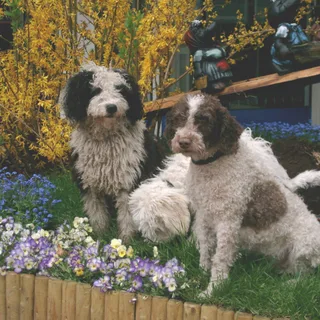
The American Water Dog is a medium-sized dog, harmoniously and solidly built, with well-developed bone structure and musculature, powerful without appearing heavy. Its head, proportionate to the body and moderately long, has a broad and strong skull as well as a moderately defined stop. Its slightly rounded eyes, from light yellowish brown to hazel or dark brown depending on the coat, express intelligence and liveliness. Its lobed ears, rather long and broad, are set slightly above the eye line. The body is harmonious and powerful, with a developed chest, well-sprung ribs and a solid loin. The tail, moderately long and curved, is carried around the line of the back and furnished with moderate fringes. The coat is uniformly wavy or formed of tight curls, with a dense undercoat that protects from water. The coat color is solid liver, brown or dark chocolate.
Temperament
Temperament and personality
Alert, energetic and intelligent, the American Water Dog shows great enthusiasm for hunting. A versatile hunter, it was notably developed to retrieve game from light boats. Its temperament is pleasant, affectionate and very attached to its owner. It is generally sociable with children and shows average compatibility with other animals and unfamiliar people.
Living together
Living with children and animals
The American Water Dog needs regular and varied activity. It must be able to walk, run, jump into the water and move through thickets when the opportunity arises, because simple short walks are not enough for it. It can live in an apartment if it is sufficiently walked and stimulated, but prefers large open spaces in the middle of or close to nature. Its coat has two seasonal shedding periods during which shedding increases, with more moderate shedding the rest of the year. Grooming and trimming the ears are possible, but are not mandatory.
Training
Training and socialization
His pronounced taste for work and his desire to please his owner make his learning easier. An education started early enough, combining a minimum of firmness to develop obedience and gentleness, makes him an excellent hunting companion and a pleasant member of the family.
Budget
American Water Spaniel price & budget
The price of an American Water Dog varies depending on the lineage, the seriousness of the breeding, the screenings and the socialization. The maintenance budget (food, veterinary care, training) often exceeds the purchase price over time.
View cost breakdownHealth
Health at a glance
The American Water Dog tolerates fairly well difficult climatic conditions and bad weather thanks to its double coat. Certain predispositions must nevertheless be monitored, notably hip dysplasia, mitral insufficiency and pulmonary stenosis.
Prevention & watch pointsDiet
Feed it well
The American Water Dog needs a complete, digestible diet adapted to its age, its activity and its body condition. An adult generally weighs from 11 to 20 kg. The quality of the ration and weight control protect digestion and joints.
Our feeding adviceDid you know?
Anecdotes and popularity
The American Water Dog is also known under the names American Water Spaniel and American Water Spaniel. Its FCI standard bears the number 301. A litter usually has 7 to 9 puppies according to the reference sheet.