Origins
Where does it come from?
The origins of the Frisian Water Dog are ancient and remain poorly known. The breed is said to have resulted from crosses between a Gypsy dog and a Frisian dog, then to have been developed in the Dutch province of Friesland. Formerly used to hunt small mammals and water birds, notably the otter, other mustelids and wildfowl, it nearly disappeared during World War II before being saved by enthusiasts. It remains rare outside its region of origin. The Fédération Cynologique Internationale recognizes it under number 221 since 1959, within group 8; it is also recognized by the AKC.
Appearance
What does it look like?
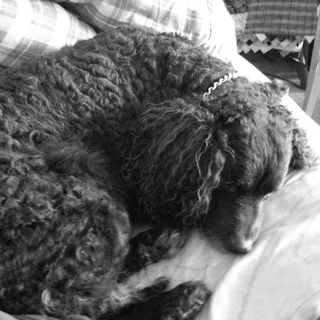
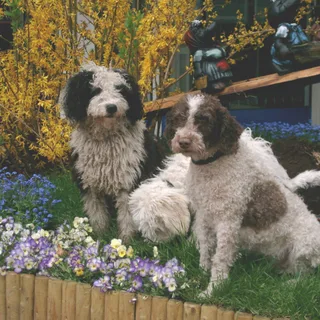
Robust, well-proportioned, strongly built and rather compact without appearing heavy, the Frisian Water Dog fits into a square. Its back is short and straight, its loin strong, its croup moderately sloping, its chest broad and its belly slightly tucked up. Its long, lean and powerful head has a slightly domed skull, a very slight stop, a strong muzzle that tapers without ending in a point and a black or brown nose depending on the coat. Its medium-length ears, set rather low and trowel-shaped, lie close to the head. Its oval eyes are dark brown in black subjects and brown in subjects with a brown coat. Its long curled tail is carried above or to the side of the croup. The coat forms thick, firm curls over almost the entire body, except the head and limbs. The coat can be solid black or brown, or black or brown with white patches.
Temperament
Temperament and personality
The Frisian Water Dog has a balanced and calm temperament, without being particularly docile. Known to be strong-willed and sometimes stubborn, it is attached to its owner and sensitive to the quality of the relationship. Its natural reserve toward strangers and its protective instinct make it a good guard dog, without unjustified aggressiveness. Its hunting instinct remains very pronounced.
Living together
Living with children and animals
On a daily basis, he is calm at home when he has had sufficient activity, but retains significant energy and a strong need to explore. Playful without excess, he enjoys outings in natural environments and activities that engage his sense of smell. Early socialization makes relationships with children and other animals easier, while his chasing instinct must still be taken into account.
Training
Training and socialization
His training requires firmness, consistency and limits set early, because he does not always obey spontaneously. Any brutality must be avoided: sensitive and very attached to his owner, he progresses better with a coherent, patient method based on positive reinforcement. Recall and the management of the hunting instinct must be worked on from a young age.
Budget
Frisian Water Dog price & budget
The price of a Frisian Water Dog varies depending on the lineage, the seriousness of the breeding, the screenings and the socialization. The maintenance budget (food, veterinarian, training) often exceeds the purchase price over time.
View cost breakdownHealth
Health at a glance
Rustic, resilient and generally robust, the Frisian Water Dog does not present, according to the reference sheet, any particular predisposition to a specific disease. A litter usually has 3 to 6 puppies. Regular veterinary follow-up remains necessary as for any breed.
Prevention & watch pointsDiet
Feed it well
The Frisian Water Dog needs a quality diet suited to its age, its size and its level of physical activity. A very active dog or one used for work requires a higher energy intake than that of a more sedentary companion.
Our feeding adviceDid you know?
Anecdotes and popularity
The Chien d'eau frison is also known under the names Wetterhoun and Frisian Water Dog. A rare breed originating from Frisia, it was notably specialized in hunting otters and waterfowl. The litter generally includes 3 to 6 puppies.