Origins
Where does it come from?
The Irish Water Dog is said to descend from Persian dogs that arrived in Ireland via the Iberian Peninsula, but this origin remains uncertain. Its ancestors were already specialized in hunting waterfowl at the beginning of the 17th century. The breed gains strongly in popularity during the second half of the 19th century, then its club is founded in 1890. The Fédération Cynologique Internationale recognizes it definitively on 28 December 1954 under standard number 124.
Appearance
What does it look like?
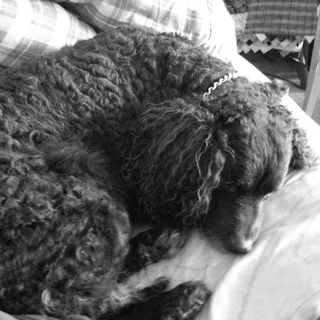
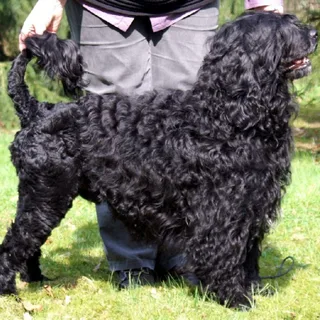
Of medium size, the Irish Water Dog has an elegant, balanced, compact and stocky silhouette, supported by a developed bone structure and musculature. Its strong and muscular body is characterized by a well let-down chest, a short and broad back and a powerful loin. The head, long and well proportioned, has a domed skull topped with soft curls, a large dark brown nose and a strong muzzle with scissor jaws. The almond-shaped eyes, dark amber to dark hazel, express intelligence. The very long, low-set and pendant ears are covered with twisted curls. The coat forms small crisp curls, dense, thick, non-woolly and oily in appearance, with a smoother V-shaped area at the throat and fringes on the forelimbs. The coat is solid brown or dark brown. Thick at the base then tapering, the tail bears short curls only on its first centimeters and is carried almost level with the back.
Temperament
Temperament and personality
Proud, intelligent, loyal and full of vitality, the Irish Water Dog is a very playful companion that becomes strongly attached to its owner. Its spirited and enduring temperament remains marked by its history as a gun hunting dog. It readily searches for water game, can behave as a pointing dog and also excels at retrieving. Its sociability with children and other animals is generally correct, but it must be reinforced by early socialization.
Living together
Living with children and animals
Very energetic, this dog needs long daily walks, complemented by games and exercises that engage both its intelligence and its physical abilities. It can live in the city and in an apartment if these needs are truly met and if it has regular access to natural areas. It nevertheless prefers a rural environment, close to marshy or brushy areas, where it can fully express its abilities as a water dog.
Training
Training and socialization
Intelligent, hardworking and very attached to its owner, the Irish Water Dog has a good learning ability, but its obedience is not automatic. Its training requires a constant balance between firmness, consistency and gentleness. Short, varied and stimulating sessions, based on play and reward, help to channel its energy without dulling its initiative.
Budget
Irish Water Spaniel price & budget
The purchase price varies depending on the lineage, the reputation of the breeding kennel, the health guarantees, compliance with the standard and the dog's intended purpose. The relative rarity of the breed can also influence availability.
View cost breakdownHealth
Health at a glance
The Irish Water Dog is generally robust and solid, but the breed has certain hereditary predispositions that justify careful selection and regular veterinary monitoring. Its active lifestyle, its curly coat and its long drooping ears also require appropriate monitoring after outdoor activities and in the water.
Prevention & watch pointsDiet
Feed it well
The diet must cover the high needs of a sporting dog while maintaining a lean and muscular silhouette. Its energy density and its quantity must be adjusted individually to age, weight, activity and body condition.
Our feeding adviceDid you know?
Anecdotes and popularity
The Irish Water Dog is also called Irish Water Spaniel or Irish Water Spaniel. Its characteristic tail, curled at the base then almost bare and tapered, is one of its distinguishing features. A litter generally has 4 to 12 puppies according to the Woopets reference sheet.