Origins
Where does it come from?
The name Barbet comes from « bearded » and refers to an old water dog whose precise origin remains difficult to trace. Dogs of this type are said to have accompanied population movements from North Africa and the Iberian Peninsula before becoming established notably in Languedoc, in Aquitaine, in Bresse and in the Alps, where their abilities for aquatic work were sought after. The breeding carried out by Vincenti revived its popularity between the two World Wars, then the breed narrowly escaped disappearance during the Second World War. Doctor Vincenti's daughter contributed to its preservation. The Fédération Cynologique Internationale definitively recognized the Barbet in 1954 under number 105. Today it remains a relatively rare French breed.
Appearance
What does it look like?
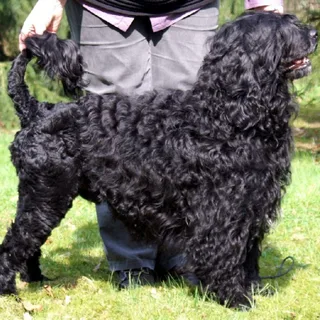
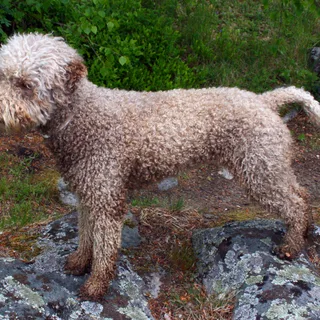
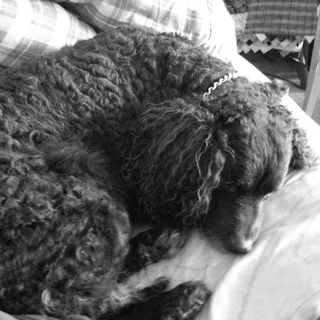
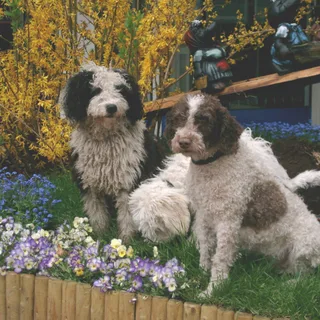
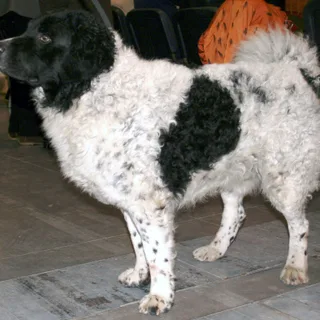
The Barbet is a medium-sized dog, solid and harmonious, whose body fits into a rectangle. Its neck is short and powerful, its back well supported, its loin short and its chest broad. Its rounded and broad head bears a beard, a moustache and long hair falling down to the nasal bridge. Its long, broad and flattened ears are set low. Its long, woolly, curly and very abundant coat can form locks and covers the whole body. It is solid black, white, grey, brown, fawn or sable. The tail, set low, forms a hook at its tip.
Temperament
Temperament and personality
Balanced, sociable and very attached to its family, the Barbet is an affectionate companion that appreciates being close to its owners. Intelligent and docile, it is generally gentle with children and sociable with other animals when it has been properly socialized. Its water dog instinct remains strong: it likes to search, retrieve and move about in water. It is not very independent and does not tolerate prolonged solitude well.
Living together
Living with children and animals
On a daily basis, the Barbet is active, playful and close to his household. He needs long outings, regular activities and mental stimulation to stay balanced. A house with a fenced garden suits him particularly well, especially near natural areas or bodies of water, but he can live in an apartment if his exercise needs are fully met. He enjoys agility, retrieving games and water activities.
Training
Training and socialization
The Barbet’s training must combine patience, gentleness, consistency and measured firmness. Its intelligence and its desire to please make learning easier, but a thoughtful and regular method remains necessary. Early socialization, recall and gradual habituation to being alone are priorities. Short, varied sessions based on reward maintain its motivation.
Budget
Barbet price & budget
The price of a Barbet depends on the quality of the breeding, the pedigree, the screenings carried out on the parents, the puppy’s intended purpose, and the reputation of the line. Its relative rarity can also influence the cost and waiting times.
View cost breakdownHealth
Health at a glance
Rustic and generally robust, the Barbet benefits from a dense coat that effectively protects it from cold and dampness. The breed has few major problems, but orthopedic monitoring and careful ear care are recommended. Regular veterinary follow-up, suitable activity and maintaining a stable weight help preserve its health.
Prevention & watch pointsDiet
Feed it well
The Barbet is generally not difficult, but its diet must be complete, balanced and proportionate to its activity. The quality of proteins, control of energy intake and good hydration are particularly important in this athletic dog.
Our feeding adviceDid you know?
Anecdotes and popularity
The Barbet owes its name to its characteristic beard. A water dog par excellence, it readily dives to retrieve game or an object, including in cold water. Its great sensitivity and attachment to humans have also led to its occasional use in hospital or psychiatric settings to promote social bonding. Its abundant, curly coat makes it immediately recognizable.