Origins
Where does it come from?
The Portuguese Water Dog is an ancient breed whose historical cradle is located in the Algarve, in the south of Portugal. Developed from local dogs with a probable influence of the Barbet, it long accompanied fishermen to retrieve fish, carry messages between boats and the shore, and watch over the equipment. Its traditional role declined with the modernization of fishing, but the breed was preserved and then spread internationally. The FCI recognized it definitively in 1955.
Appearance
What does it look like?
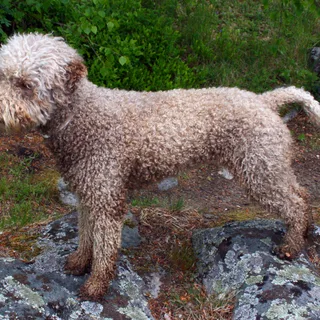
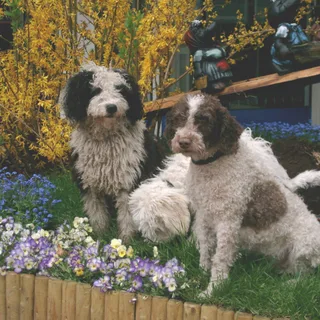
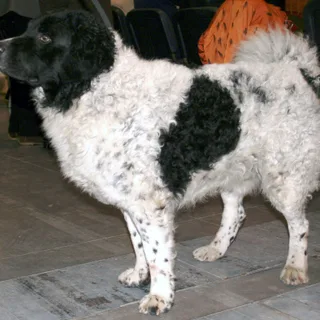
The Portuguese Water Dog is a medium-sized dog, solid, harmonious and well muscled. Its body is built for endurance and swimming, with a well let-down chest, a straight back, a powerful neck and a strong tail carried in a ring when it is attentive. Its coat is abundant, dense and devoid of undercoat, with two accepted varieties, one wavy and long, the other shorter and curly. The most frequent colors are black, brown or white, sometimes with white markings.
Temperament
Temperament and personality
Very intelligent, willing and docile, the Portuguese Water Dog combines enthusiasm for work and deep attachment to its owner. It is loyal, courageous and well-balanced, while generally remaining sociable with its family and able to live well with other animals when properly socialized. Its active temperament and liveliness make it a pleasant companion for present and dynamic households.
Living together
Living with children and animals
The Portuguese Water Dog needs daily interactions and does not tolerate boredom or prolonged isolation well. It likes to swim, play, explore and take part in family life. In a house with a garden, it must not be left alone outside for long hours, because it seeks above all the closeness of its humans. In the city, it can adapt if its outings are regular, varied and sufficiently stimulating.
Training
Training and socialization
The education of the Portuguese Water Dog is generally accessible thanks to its intelligence, its desire to please and its good receptiveness to work. A consistent, early method based on positive reinforcement gives excellent results. It is useful to start socialization early, notably with strangers and lively environments, in order to maintain a well-balanced and confident dog.
Budget
Portuguese Water Dog price & budget
The purchase price of the Portuguese Water Dog varies mainly depending on the quality of the lineage, the seriousness of the breeding and the health guarantees provided. A breed still relatively uncommon, it may require patience to find a well-selected breeder.
View cost breakdownHealth
Health at a glance
The Portuguese Water Dog is generally robust and hardy, but like many selected breeds, it has hereditary predispositions that justify careful monitoring. Serious selection of breeding dogs, regular ear care and periodic veterinary check-ups help to better prevent or detect early several problems known in the breed.
Prevention & watch pointsDiet
Feed it well
The Portuguese Water Dog needs a good-quality diet adapted to its age, its weight and above all its activity level. A naturally athletic dog, it benefits from a balanced ration that supports its muscle mass, its recovery and the health of its skin and coat.
Our feeding adviceDid you know?
Anecdotes and popularity
Emblematic breed of the Portuguese coastline, the Portuguese Water Dog long served as an assistant to fishermen thanks to its swimming abilities and its keen sense of smell. It gained more recent worldwide visibility after the adoption of a representative of the breed by Barack Obama's family, which helped to make this dog, still relatively rare outside Portugal, better known.