Origins
Where does it come from?
The development of the Briquet Griffon Vendéen and its first selections began shortly before the First World War. The work was mainly based on the Grand Vendéen, whose breeders sought a smaller version corresponding to the current type. Numbers declined sharply after the two world conflicts, before experiencing a recovery from 1946. The Fédération Cynologique Internationale definitively recognized the breed on 2 October 1954 under number 19, in group 6. The official current FCI standard was published on 9 January 1999.
Appearance
What does it look like?
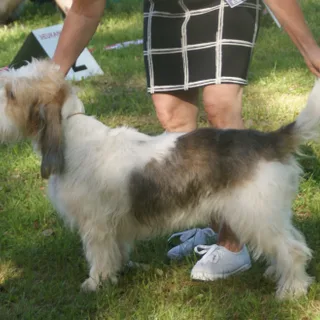
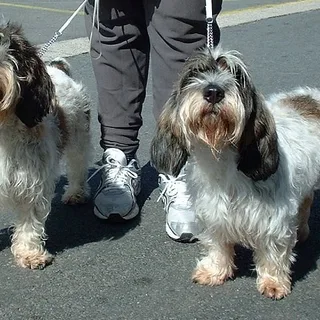
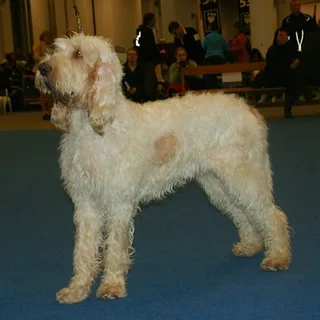
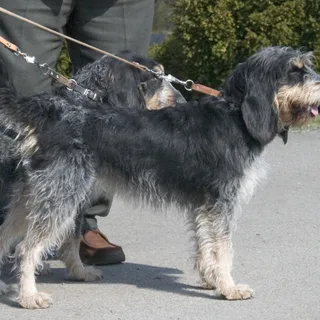
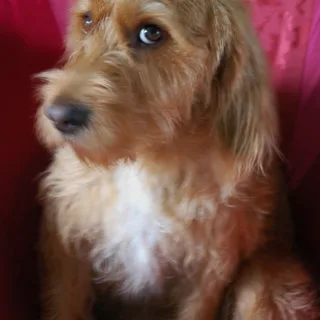
Of medium size and of rather compact build, the Briquet Griffon Vendéen is harmoniously proportioned and displays active and free-moving gaits. Its light head has a moderately domed skull, a marked stop, a strong black or brown nose and a straight and short muzzle. Its large dark eyes are lively, while its narrow, supple ears, set below the line of the eye, end in a point. The body is robust, with a short and straight back, a muscular loin and a chest developed in height. The tail, rather short and thick at the base, is carried like a sabre blade. Its long, harsh and sometimes bushy coat covers a dense undercoat. Accepted coat colors include white and black, black and tan, black with sable markings, white and orange, tricolor, fawn with black overlay and sable with black overlay, with or without white markings depending on the color.
Temperament
Temperament and personality
Passionate about hunting, the Briquet Griffon Vendéen has a remarkable spirit of initiative, a keen nose, speed, tenacity and endurance. It is mainly used as a scenthound for driven shooting of big game, hare and fox. Within its family, it is gentle, affectionate and never aggressive, especially with children. Its independent and sometimes stubborn temperament nevertheless requires a consistent framework.
Living together
Living with children and animals
This active dog has a great need for exercise and enjoys long daily outings, hiking, jogging and games with its owner. It is especially suited to a rural environment, but can live in the city if it benefits from sufficient walks. Its hunting instinct may encourage it to follow a trail and to wander off, which requires securing outings and working on recall.
Training
Training and socialization
Recall training must begin from the youngest age, because the Briquet Griffon Vendéen can follow a trail that attracts it. Obedience must also be worked on early, with consistency and without a power struggle. Intelligent but sometimes very stubborn, it makes better progress with regular, clear and motivating sessions.
Budget
Briquet Griffon Vendéen price & budget
The purchase price varies depending on the breeder, the lineage, the age and the dog's intended use. The estimated annual maintenance cost according to the reference sheet is between 400 and 600 euros, excluding exceptional veterinary expenses.
View cost breakdownHealth
Health at a glance
Rustic and robust, the Briquet Griffon Vendéen generally enjoys solid health. Its double coat, long and well furnished, protects it quite well from the cold and bad weather. Regular veterinary monitoring remains necessary, notably for the hips, the ears, hearing, the thyroid and any potential neurological or allergic disorders.
Prevention & watch pointsDiet
Feed it well
The Briquet Griffon Vendéen is not known to be difficult in terms of diet. A balanced, high-quality industrial diet, adapted to its activity, its age and its size, covers its usual needs.
Our feeding adviceDid you know?
Anecdotes and popularity
The word “briquet” traditionally refers to a medium-sized scenthound. Resulting from a selection aimed at reducing the size of the Grand Vendéen, the Briquet Griffon Vendéen was recognized by the FCI in 1954. A litter generally consists of 4 to 6 puppies.