Origins
Where does it come from?
The Grand Basset Griffon vendéen descends from large griffons, like many bassets. Its selection intensified from the end of the 19th century, with a search for straight-legged subjects advocated by Count d'Elva. Paul Dezamy then developed the breed in order to improve its hunting qualities. Faster than most bassets, this versatile dog was used to hunt hare, rabbit and wild boar. The Fédération Cynologique Internationale definitively recognized the breed, registered under number 33 in group 6, on 17 January 1967.
Appearance
What does it look like?
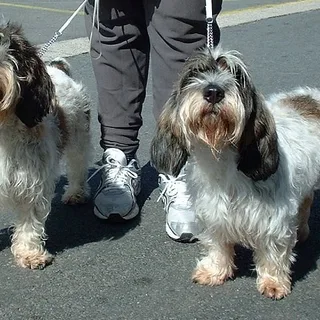
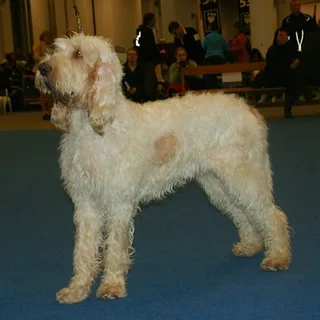
Medium-sized hunting dog, the Grand Basset Griffon vendéen has a slightly elongated basset build, harmonious and elegant, with straight limbs and free-moving gaits. Its back is long, broad and straight, its loin solid and muscular, and its chest ample and well let down. Its elongated head remains without heaviness, with a marked stop, a muzzle longer than the skull and drooping lips furnished with moustaches. Its large oval dark eyes express liveliness, friendliness and intelligence. Its ears, set below the line of the eye, are supple, narrow and elongated. Its flat, harsh coat, neither silky nor woolly, forms moderate fringes and full eyebrows. The coat can be solid-colored, bicolored or tricolored. Its tail, thick at the base and set high, is carried sabre-like or slightly curved.
Temperament
Temperament and personality
Passionate about hunting, determined and fearless, the Grand Basset Griffon Vendéen does not hesitate to move forward in brushy terrain and brambles. It is appreciated for its courage and speed, but also has a strong-willed side that requires intelligent and firm handling. A born hunter, it can also be a pleasant companion dog.
Living together
Living with children and animals
Very energetic and athletic, the Grand Basset Griffon vendéen needs to stay active every day thanks to long and frequent walks, ideally in natural areas. It prefers a setting close to nature, but can adapt to urban life if it benefits from outings, daily stimulation and a large fenced area to let off steam. It is playful, very attracted to hunting and particularly vocal.
Training
Training and socialization
Recall training is essential in this active and somewhat stubborn dog. Its education must be conducted with great firmness, consistency and intelligence, without any brutality.
Budget
Grand Basset Griffon Vendéen price & budget
The acquisition budget indicated for this breed falls within a relatively affordable range, with possible variations depending on the individual offered.
View cost breakdownHealth
Health at a glance
The Grand Basset Griffon vendéen is described as a robust and hardy dog, with sound health and no particular predisposition reported. However, vigilance is still necessary regarding its ears, as the risk of otitis cannot be completely ruled out.
Prevention & watch pointsDiet
Feed it well
The Grand Basset Griffon vendéen needs a complete, digestible diet adapted to its age, its activity and its body condition. An adult generally weighs from 17 to 20 kg. The quality of the ration and weight control protect digestion and joints.
Our feeding adviceDid you know?
Anecdotes and popularity
Its speed has enabled it to hunt furred game of varying sizes, from rabbit to wild boar. Representatives of the breed have also distinguished themselves in competitions, notably during the 5th edition of the European Cup on hare. The breed was definitively recognized by the FCI on 17 January 1967 under number 33.