Origins
Where does it come from?
The Sussex-Spaniel originates from Sussex, in the south of England. It is among the oldest Spaniel breeds and developed in the 18th century as an enduring and methodical hunting dog. The breed nearly disappeared after the Second World War, then was preserved by a few passionate breeders, notably in Great Britain. Despite these efforts, it remains very rare today, including in France, where the breeding offer remains limited. The Fédération Cynologique Internationale recognized it definitively on 31 December 1954.
Appearance
What does it look like?
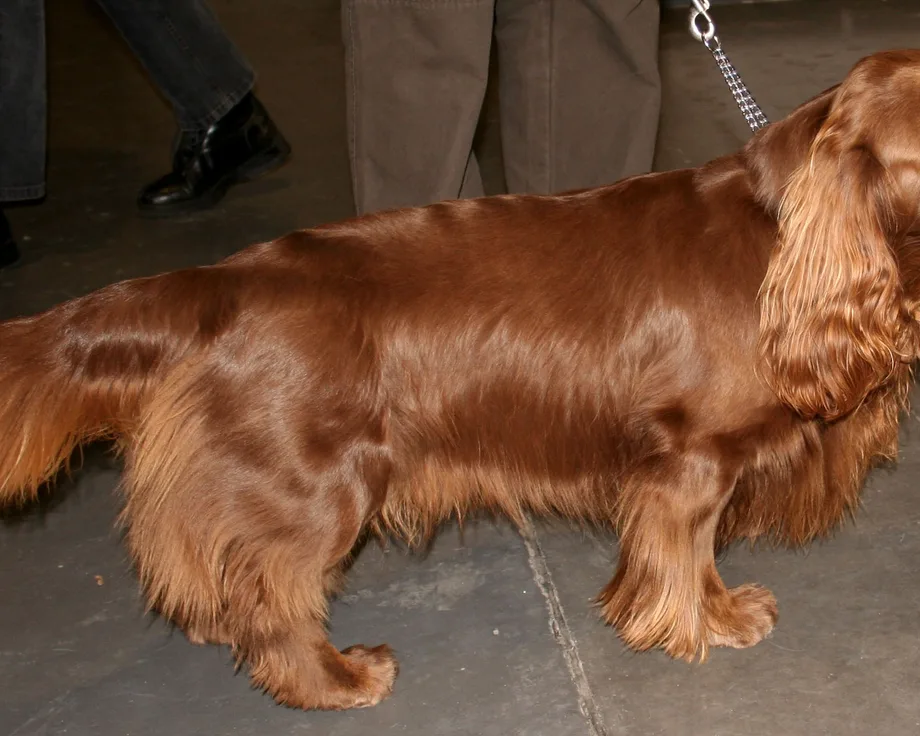
The Sussex-Spaniel is a medium-sized dog, but of massive, solid and elongated build. Its body is strong, horizontal and well muscled, with a deep chest. Its head is broad and well proportioned, with a pronounced stop, hazel eyes with a gentle expression and large low-set ears furnished with fringes. Its coat is abundant, flat, never curly, with a dense undercoat that protects it well from bad weather. The desired color is an intense golden brown, lighter towards the extremities.
Temperament
Temperament and personality
The Sussex-Spaniel is an affectionate, cheerful and pleasant dog to live with as a family. He is energetic, active and hard-working, while keeping an underlying calm and composed nature at home if his needs are respected. When hunting, he is tenacious, expressive and readily vocal. With other dogs, he gets along rather well, but can show a certain temperament and a tendency toward dominance if his socialization is insufficient.
Living together
Living with children and other pets
This dog needs to stay busy and to benefit from long daily walks to maintain a good balance. It enjoys life in the countryside, where it can explore and follow trails, but can also adapt to the city if its physical and mental activity is sufficient. Its gait is characteristic, rolling and compact, which distinguishes it from other Spaniels.
Training
Training and socialization
The Sussex-Spaniel requires early, consistent and fair training. Its socialization must be worked on early, in particular to limit dominant behavior toward other dogs. It responds well to a firm framework without brutality and to regular, varied and motivating sessions. Its attachment to its family and its good level of obedience make it a receptive dog when it is guided with consistency.
Budget
Price and budget for the Sussex Spaniel
The Sussex-Spaniel is a rare breed, which strongly influences its availability and the conditions of acquisition. In France, the low number of breeders can lengthen waiting times and limit the choice of litters.
See cost breakdownHealth
Health at a glance
The Sussex-Spaniel is an overall fairly robust dog, notably thanks to its double coat which provides it with good protection against bad weather. Like many old hunting breeds, it tolerates an active life well, but it also has some hereditary predispositions that should be monitored seriously throughout its life.
Prevention and things to watch forNutrition
Feeding your pet well
The Sussex Spaniel needs a complete, digestible and well-balanced diet, adapted to its age, its weight and its activity level. The quality of the ration matters particularly during growth, which must remain progressive in order to spare the joints and the dog's overall development.
Our feeding adviceDid you know?
Fun facts and popularity
The Sussex Spaniel is one of the rarest dog breeds. The British Kennel Club has even classified it among threatened breeds, and its distribution remains very limited. Its name comes directly from its county of origin in England, and its very distinctive style of movement is one of its most recognized distinguishing features.