Origins
Where does it come from?
The Oriental Shorthair comes from the same breed foundation as the Siamese, from which it takes the silhouette, temperament and large ears, but without a colourpoint coat. The breed was developed in the United Kingdom in the middle of the 20e century by breeders who were seeking to obtain a Siamese-type cat in a wide variety of solid colors and patterns. Although its ancestors are linked to Siamese-type cats originating from Thailand, the Oriental Shorthair is today recognized as a distinct breed, created by modern selective breeding.
Appearance
What does it look like?
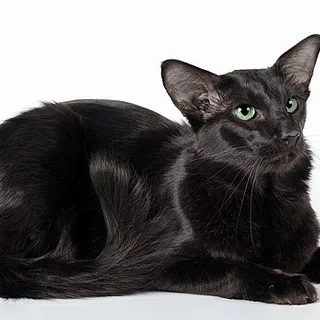
The Oriental Shorthair is a medium-sized cat with a long, slender, firm and muscular body. Its bone structure is delicate without being fragile. Its head forms a long triangle, its ears are very large and wide at the base, and its almond-shaped eyes are most often an intense green. Its coat is very short, lying close to the body, shiny and silky to the touch. All colors and many patterns are accepted, with the exception of the colourpoint reserved for the Siamese.
Temperament
Temperament and personality
Very close to the Siamese in character, the Oriental Shorthair is demonstrative, intelligent, curious and particularly attached to its home. It readily seeks interaction, often follows its human around the house and easily expresses its needs by voice. Affectionate and playful, it greatly appreciates company and does not cope well with a life that is too solitary. Its temperament can also be assertive, with a degree of tenacity and sensitivity.
Living together
Living with children and animals
This cat needs presence, stimulation and an enriched environment. It likes to climb, observe from up high, play and take part in the daily life of the household. In an apartment as well as in a secure house, it adapts well if its social and mental needs are respected. Very communicative, it can be talkative, sometimes insistent, especially if it is bored or if it lacks attention.
Training
Training and socialization
The Oriental Shorthair learns quickly when you focus on consistency, rewards and positive interactions. Its intelligence makes it easier to learn routines, transport, enrichment games and certain simple exercises, but its strong-willed temperament requires patience rather than an authoritarian approach. Early socialization and a stable framework help it become a balanced companion and pleasant to live with.
Budget
Oriental Shorthair price & budget
The purchase price varies mainly depending on the quality of the lineage, compliance with the standard, the reputation of the cattery and the socialization work carried out on the kittens. A higher range is often explained by serious health monitoring and rigorous selection.
View cost breakdownHealth
Health at a glance
The Oriental Shorthair is overall a rather healthy and robust breed. Its very short coat makes daily care easier, but the fineness of its coat makes it more sensitive to cold than cats with a denser coat. As with breeds related to the Siamese, a measured vigilance remains useful regarding certain hereditary or functional disorders.
Prevention & watch pointsDiet
Feed it well
The Oriental Shorthair benefits from a high-quality diet, easy to digest and adapted to its age, its activity level and its individual sensitivity. Its apparent slenderness must not lead to an unstructured diet: it needs regular and well-measured intakes.
Our feeding adviceDid you know?
Anecdotes and popularity
The Oriental Shorthair is often described as a multicolored Siamese. Its very slender silhouette, its spectacular ears and its wide palette of colors make it one of the most recognizable breeds of the oriental group. It is also known for its cat-dog side, because it likes to follow its human from one room to another and stay at the heart of the action.