Origins
Where does it come from?
The Havana Brown was developed in the United Kingdom in the 1950s by breeders wishing to establish a solid brown coat in an Oriental-type cat. The breed descends from matings involving, in particular, Chocolate Siamese and black shorthair cats. Officially recognized in 1964 in the United States, it remains rare today. Its distant origins, however, go back to brown cats from Southeast Asia, which explains its relationship with the Siamese.
Appearance
What does it look like?
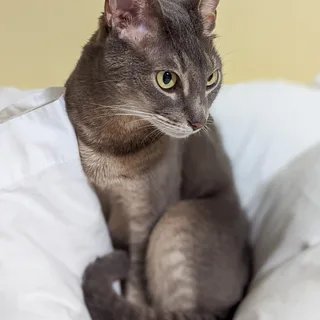
The Havana Brown is a medium-sized cat with a muscular, elegant and well-proportioned body. Its silhouette can be a little more rectangular in the American type and finer in the English type. Its head is longer than it is wide, with a very characteristic square muzzle. The ears are large and slightly tilted forward, the oval eyes are always green, and the coat must be uniform, in a deep mahogany brown or lilac, without white hairs or tabby pattern. The coat is short, smooth, soft and silky.
Temperament
Temperament and personality
The Havana Brown is an expressive cat, close to its family and particularly attached to its owner. Affectionate without being unruly, it appreciates comfort, calm and daily interactions. Playful and curious, it likes to observe its environment and take part in household life. It can be a little exclusive with its reference human and tolerates long absences moderately.
Living together
Living with children and animals
This cat readily lives indoors, where it alternates naps, observation and play sessions. It likes to climb on a cat tree, explore its environment and come to seek petting. The Havana Brown vocalizes more than many other cats, with a raspier voice than that of the Siamese, without being constantly noisy. With respectful children, it is generally sociable and playful.
Training
Training and socialization
The Havana Brown responds well to gentle, consistent education based on routine. As it is intelligent and close to humans, it easily learns the household rules if they are set early. The use of positive reinforcement, interactive games, and stable reference points promotes good balance. It is important to offer it activities and regular interactions to avoid boredom.
Budget
Havana Brown price & budget
The Havana Brown is a rare breed, which explains an acquisition cost that is often higher and limited availability. The price depends mainly on the quality of the breeding, the pedigree, the lineage and the rarity of the kittens offered.
View cost breakdownHealth
Health at a glance
The Havana Brown is generally considered a robust cat, with few reported hereditary problems. Its overall health is good provided it benefits from regular veterinary follow-up, an appropriate diet and a balanced indoor lifestyle.
Prevention & watch pointsDiet
Feed it well
The Havana Brown needs a complete, good-quality diet, adapted to its age, activity level and physiological condition. As with many indoor cats, the regularity of meals and the energy density of the ration deserve particular attention.
Our feeding adviceDid you know?
Anecdotes and popularity
The Havana Brown is one of the rare feline breeds selected for a solid chocolate coat that is so characteristic. Its square muzzle is often described as one of its most easily recognizable distinguishing features. Despite its name, the breed is not originally from Cuba and remains uncommon, including in countries where it has been recognized for a long time.